Most people who want to read more books in a year set a yearly target, feel behind by February, then quietly give up. The number was never the problem. A year is too far away to tell you what to do tonight, and tonight is where reading actually happens or doesn't.
This guide treats the yearly total as an outcome, not a target. You set a small daily habit and you choose the right books, and the shelf of finished books fills itself. For the pure math behind the pace, see how many books 10 pages a day adds up to; for picking the goal itself, see reading goals for adults. This page is about the two levers those guides leave out: the yearly outcome, and the books you actually read.
Aim at the day, let the year follow
A yearly goal is motivating for a week and discouraging after that, because you can always feel behind. A daily number is the opposite: it is small, clear, and you either did it or you did not. Hit it most days and the year takes care of itself.
The arithmetic is friendlier than people expect. Ten pages a day is 3,650 pages across the year, which is about 12 books of 300 pages, or roughly one a month, from a habit that takes ten quiet minutes. You never have to think about the big number again, because every day already tells you whether you are on track.
So pick a daily page count you could hit even on a tired, busy day. Five pages is plenty to start. The point is not to be impressive. It is to never break the chain, since a chain you keep is worth far more than a target you abandon.
Build a TBR and stack your books
The fastest way to read more over a year is to stop reading books you feel you should like. Choice, not willpower, is what keeps the pages turning, so give yourself a short, tempting to-be-read list and permission to use it loosely.
- Keep a running TBR. A list of six to ten books you genuinely want means you never finish one and stall, wondering what is next. Add to it whenever a friend or a review sparks real curiosity, not duty.
- Quit at page 50. If a book still bores you by page 50, close it and pick the next from your list. A finished fun book beats an abandoned important one every time, and guilt reading is how whole months disappear.
- Stack lighter and heavier. Keep two books going at once, one easy and one demanding, and read whichever matches your energy. A thriller on a wrung-out evening keeps the streak alive that a dense biography would have killed.
- Re-read on purpose. An old favorite is one of the surest ways to rebuild momentum, because you already know you will want to turn the page.
Momentum matters more than prestige. The readers who finish 20 books in a year are rarely the most disciplined; they are the ones who were always a little impatient to get back to a book they loved.
How a year of pages adds up
It is easier to keep a habit you can see, and the yearly outcome is just your daily number, repeated. These figures assume an average book of 300 pages; swap in the length of what you actually read and the shape holds.
| Pages a day | Pages a year | Books a year (300 pages) |
|---|---|---|
| 5 | 1,825 | about 6 |
| 10 | 3,650 | about 12 |
| 20 | 7,300 | about 24 |
None of these rows is better than the others. A year of six long books you loved is a great reading year. You control the pages; the books follow. For shorter or longer books and a fuller breakdown, the 10 pages a day guide has the whole table.
Protect one reading time
A habit sticks when it has a home. Attach your pages to something that already happens every day, so you stop deciding whether to read and simply read:
- With your morning coffee, before the first feed.
- On your commute, if someone else is driving.
- The ten minutes after dinner, before the sofa pulls you in.
- In bed, instead of one last scroll.
Pick one and guard it. A visible run of days is its own motivation, which is why tracking a reading streak keeps so many readers going long after the first enthusiasm fades. If you are starting from a long gap rather than a steady habit, how to get back into reading covers the gentler on-ramp.
Remove the thing that eats your reading time
For most people the competition is not other books, it is the phone. An hour of scrolling is an hour you could have read. You do not have to quit your apps. You just have to stop letting them be the automatic first choice.
- Keep a book where you usually scroll: the couch, the nightstand, your bag.
- Read your pages before you open any feed.
- Put the apps that pull you in behind one small step, so reaching for them is a decision instead of a reflex.
How ReadFirst helps you read more this year
ReadFirst is built around a small daily page goal and the habit of reading before the feed. You choose the apps to lock with Apple Screen Time, and to open them you read a page of a printed book and take a live photo of it, checked on your iPhone and never saved.
- A daily page goal. Set a small number with your reading goal and watch Today count toward it, so the yearly total stays an afterthought.
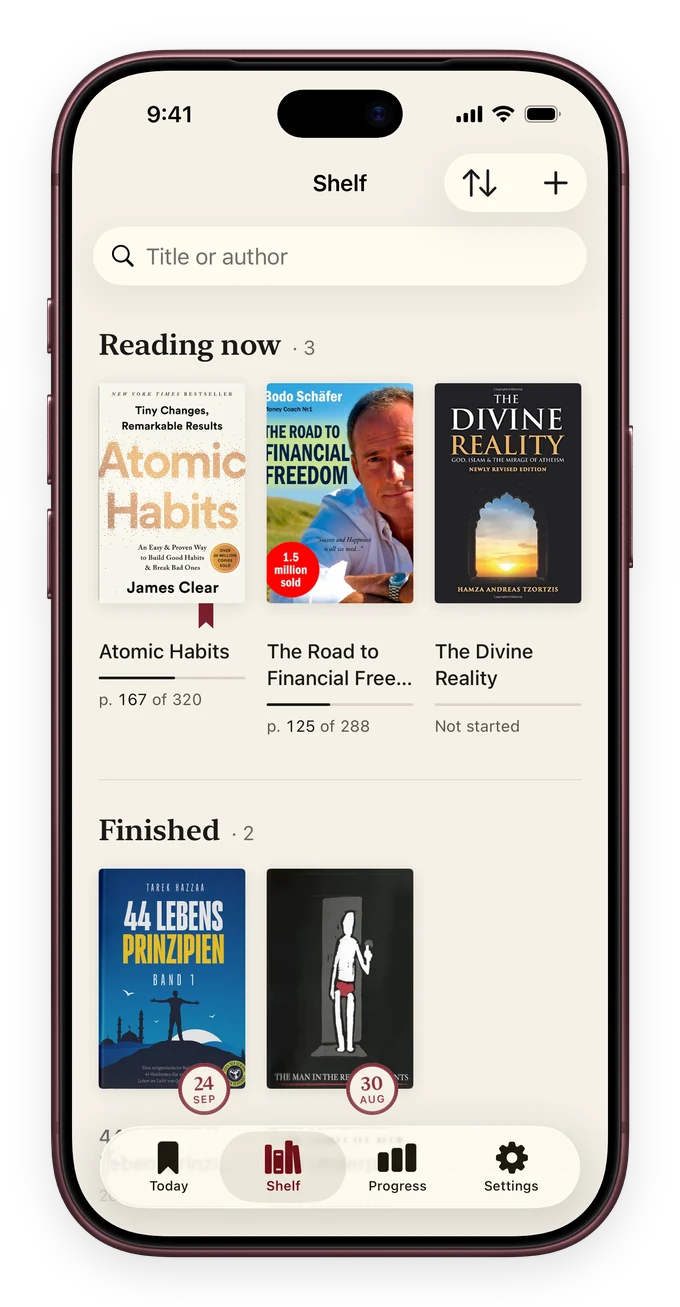
- A shelf and a log. The book tracker holds your current reads and your TBR, counts pages toward each book, and marks the ones you finish, turning a year of sessions into a visible stack.
- A streak that forgives. A day counts when you read, and one grace day a month keeps a good run alive when life gets in the way.
Set your number low enough to keep on a bad day, line up books you want to finish, protect one reading time, and let a year of small sessions do the rest.
Frequently asked questions
How many books can I realistically read in a year?
More than you think. Ten pages a day is about 3,650 pages, roughly a book a month, so a small daily habit can mean a dozen or so books of 300 pages across the year without any long sessions.
Is it better to set a daily or a yearly reading goal?
A daily goal works better for most people, because a yearly number is easy to fall behind on while a small page count is clear and easy to keep. Treat the yearly total as something you watch grow, not the target you chase; reading goals for adults goes deeper.
How many books should I keep on my TBR?
Enough that you are never stuck choosing, but not so many that it feels like homework. Six to ten books you genuinely want to read is a good range, and it is fine to swap titles in and out as your mood changes.
Should I finish every book I start?
No. If a book still bores you by page 50, set it aside and move to the next on your list. Reading more over a year depends on momentum, and forcing a book you dislike is the surest way to stop reading altogether.
How do I find time to read more?
Attach reading to a moment you already have, like your morning coffee or the time before sleep, and read a few pages before you open any feed. Protecting one small, fixed slot beats hunting for a free hour that never comes.