You open the book. You read a paragraph, then realize you have no idea what it said. You read it again. Somewhere in the middle of the second try, your hand is already reaching for the phone. You used to lose whole afternoons in books. Now one page feels like work.
If you have typed "why can't I read books anymore" into a search bar, you are far from alone. It is one of the most common things readers say about themselves, and it usually has a plain, fixable cause. This guide explains what is happening and gives you a gentle way back.
Why can't I read books anymore?
For most people, the honest answer is that their attention has been trained for something else. Hours of feeds, short videos and notifications teach your brain to expect a new thing every few seconds. A book offers one thing for a long time. The mismatch feels like "I can't focus", but it is closer to "I'm out of practice".
That framing matters. "I can't read anymore" sounds permanent. "I'm out of practice" sounds like something you can change, because it is.
Other everyday reasons often add to it:
- Tiredness. Reading only at the end of a long day, when your mind is spent, makes every page harder.
- The wrong book. Pushing through a book you feel you should like drains motivation fast.
- The phone in reach. Every buzz, or just the thought of one, pulls you out of the page.
- Big expectations. Trying to read for an hour after years away is like running a long race after years on the couch.
If trouble concentrating comes with other worries, such as sleep problems, low mood or difficulty in every part of life, it is worth talking to a doctor. This guide is about everyday reading habits, not medical conditions.
It is not a character flaw
Struggling to read after years of feeds is a normal response to how most of us now use our phones. Feeds are designed to be hard to put down. Your attention adapted to what you gave it most often. That is what attention does.
Blaming yourself tends to make things worse. Shame makes reading feel like a test you keep failing, and nobody wants to sit down for a test at 10 pm. Treat it like getting back into any skill: start small, expect a few clumsy days, and count small wins.
Can't focus on reading? What actually helps
When you can't focus on reading, the fix is usually to make each session shorter and easier, not longer and more determined. Here is what tends to work.
Read less, more often
Five pages a day beats fifty pages once a week. Short daily sessions give your attention many small chances to settle, and each one is easy to start. Over a few weeks, the sessions often grow on their own.
Use a timer, not a goal for the whole book
Set a timer for 10 minutes and read until it rings. A clear end makes starting easier, because you know exactly what you are signing up for. If you want to keep going when it rings, keep going.
Pick an easy, gripping book
Choose something you would read for fun: a thriller, a memoir, a short novel, a book a friend loved. Re-reading an old favorite is a great way back. Save the dense classic for later.
Put the phone in another room
Not face down on the table. In another room. Out of sight is easier than resisting, so remove the choice.
Read on paper
A printed book has nothing else on it. No feed, no notifications, no other app one swipe away. Many people find it much easier to stay with a page on paper than on a phone.
A two-week plan to retrain your attention
Attention for reading comes back with steady, small practice. This plan asks for about 10 minutes a day.
| Days | What you do | Why |
|---|---|---|
| 1 to 3 | Read 2 pages a day, any time | Prove you can start |
| 4 to 7 | Read 5 pages or 10 minutes a day | Build a daily rhythm |
| 8 to 10 | Read 10 minutes at the same time each day | Tie reading to a cue |
| 11 to 14 | Read 10 to 20 minutes, phone in another room | Stretch focus gently |
If you miss a day, simply read the next day. One missed day does not undo anything. A good rule of thumb is to never miss twice in a row.
At the end of two weeks, look back. Most people find they read more pages than they expected, and that the last few sessions felt very different from the first.
Make the feed the harder choice
It is much easier to focus on reading when the feed is not one tap away. You can make the switch from scrolling to reading easier by making scrolling a little harder:
- Log out of one social app for the two weeks.
- Move social apps off your Home Screen.
- Keep a book where you usually scroll: the couch, the nightstand, your bag.
- Read a few pages before you open any feed, and see if you still want it.
That last one is the strongest. When reading comes first, you are not fighting the urge to scroll. You are using it as a reminder to read.
How ReadFirst helps you rebuild the habit
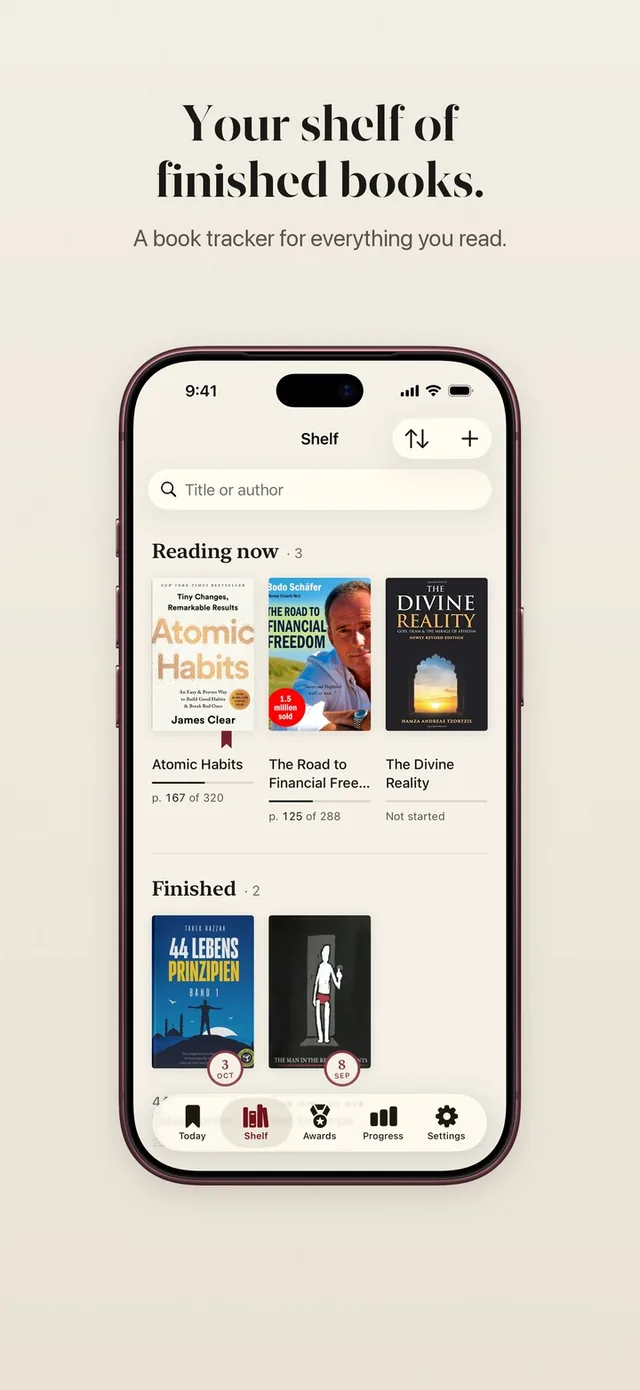
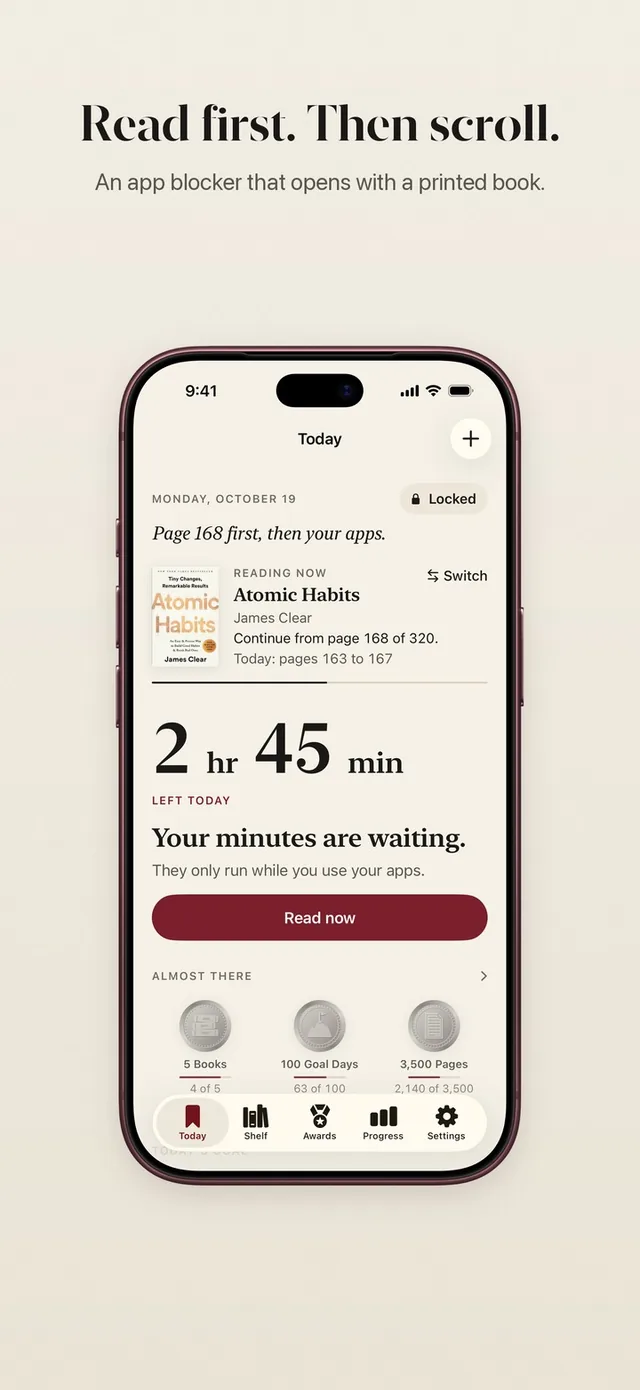
ReadFirst is built for exactly this: short, daily reading that comes before the feed. You choose the apps to lock with Apple Screen Time. To open them, you read a page of a printed book and take a live photo of it. Your rule decides how much time a page gives, so you can start with something as gentle as one page for 15 minutes.
A few parts of the app are made for getting your focus back:
- The reading timer. Tap Read now and a clock starts. It shows on your Lock Screen as a Live Activity, so you can see your session without opening anything else.
- A daily page goal. Pick a small number, like 5 pages, and Today shows how close you are.
- A reading streak that forgives. A day counts when you read, and one grace day a month keeps your streak alive when life gets in the way.
- Medals for small wins. Your first 100 pages and your first 7 days in a row each earn a medal, so early progress feels real.
You do not need an app to use the plan above. But if you have tried before and the phone kept winning, a lock that asks for one page first can be the difference.
When reading starts to feel good again
Most people do not notice the exact day it changes. One evening you look up and realize you read 20 pages without checking the time. That is the moment you have been working toward, and it usually arrives sooner than you expect.
From there, the habit carries itself. If you want ideas for the next step, our guide on how to get back into reading covers choosing books and building a routine that lasts.
Frequently asked questions
Why can't I focus on reading anymore?
Usually because your attention is used to short, fast content and a page asks you to stay with one thing. It is a matter of practice, and short daily reading sessions bring it back.
How long does it take to get my reading focus back?
It differs from person to person, but many people notice a change within one to two weeks of reading a few pages every day. Consistency matters more than session length.
Is it normal to reread the same paragraph over and over?
Yes, it is very common, especially when you are tired or the phone is nearby. Try shorter sessions, an easier book and putting the phone in another room.
Should I read on paper or on my phone?
A printed book is often easier, because nothing else competes for your attention on the page. On a phone, notifications and other apps are always one tap away.
Can't concentrate on reading at all: should I see a doctor?
If trouble concentrating affects many parts of your life, or comes with sleep problems or low mood, it is a good idea to talk to a doctor. For everyday reading slumps, small daily habits usually help.