You pick up your phone to check one thing. Forty minutes later you are still on the couch, thumb moving, a little tense, and you could not say what you just saw. The book you meant to read sits on the table where it has been for a week.
Doomscrolling vs reading is not a fight between good people and bad people. Both are ways of spending attention. They just spend it very differently, and they leave you in a different place when you stop. Once you see the difference clearly, it gets much easier to choose the one you actually want.
What doomscrolling is
Doomscrolling is the habit of scrolling through a feed for far longer than you meant to, often through news or posts that make you feel worse. The word became widely used in 2020, but the pattern is older: a feed that never ends, a thumb that keeps going, and a feeling that the next post might be the one that matters.
Three things make it so sticky:
- No natural end. A book has chapters. A feed has no last page, so there is never a moment that tells you to stop.
- Variable reward. Most posts are dull, some are interesting, a few are great. Not knowing which comes next keeps you swiping.
- Low effort to continue. One small movement brings the next thing. Stopping takes a decision; continuing takes none.
None of this means something is wrong with you. Feeds are designed by large teams to be easy to keep using. Willpower alone is a weak tool against something that well tuned.
What reading does differently
Reading asks your attention to stay on one line of thought for a while, and it rewards you for staying. A story or an argument builds. Page 40 makes more sense because you read page 39. That sense of progress is something a feed cannot give you, because nothing in a feed builds on what came before.
A book also ends. Chapters give you natural places to stop, and the last page gives you something a feed never does: the feeling of having finished. Many readers describe that moment as the best part of the habit.
Doomscrolling vs reading, side by side
The clearest way to compare them is by what they ask of you and what they leave behind.
| Doomscrolling | Reading a book | |
|---|---|---|
| Attention | Jumps every few seconds | Stays on one thread |
| Where it ends | Nowhere, the feed refills | End of chapter, end of book |
| Effort to start | Almost none | A little (open the book, find the page) |
| How you feel after | Often restless, a bit drained | Often calmer, a bit fuller |
| What remains | Fragments you mostly forget | A story or idea you can carry |
| Sense of progress | None | Page numbers going up |
The row that matters most is "effort to start". Reading wins almost every row except that one, and that single row decides most evenings. This is why "just read more" rarely works. The fix is to change the effort, not to try harder.
What is bloom scrolling?
Bloom scrolling is the practice of deliberately filling your feed with uplifting, beautiful or useful content, such as good news, art, nature or recipes, instead of distressing posts. It is a direct answer to doomscrolling: same habit, kinder diet.
It can help. Following accounts that make you feel good is a real improvement over a feed full of alarm. But bloom scrolling still keeps the parts of the feed that pull you along: no end, quick jumps, little effort. You may feel better while scrolling and still look up an hour later wondering where the evening went.
Think of bloom scrolling as cleaning up the menu, and reading as sitting down for a proper meal. Both have a place. Only one of them asks your focus to stay in one place.
Attention and mood: what changes when you switch
Most people who swap part of their scrolling for reading notice the same few things within a couple of weeks. These are common experiences, not medical promises.
- Longer stretches of focus. The first sessions feel jumpy. After a week of short daily reading, it often gets easier to stay with a page.
- Calmer evenings. A book has no notifications, no comments and no breaking news. Many people find that alone lowers the noise in their head.
- Something to show for the time. Ten minutes of feed leaves nothing. Ten minutes of book leaves you ten pages further, and that adds up.
- A different identity. After a few weeks you stop being someone who means to read and become someone who reads.
If your attention feels worn down right now, that is normal. Our guide on why it feels hard to read books anymore walks through how to rebuild it gently.
The trade: pages first, feed after
The simplest fix is not to quit your phone but to change the order: read a few pages first, then scroll if you still want to. You keep the feed. You just pay for it with a little reading.
This works because it uses the moment you already have. The urge to open an app is a cue that shows up many times a day. Instead of fighting it, you attach reading to it. The cue stays the same; what happens next changes.
Here is how to make the trade on your own:
- Keep one printed book where you scroll. On the couch, on the nightstand, in your bag.
- Set a tiny rule. One page before any social app. Small enough that you cannot argue with it.
- Make the feed slightly harder. Move social apps off your Home Screen or into a folder on the last page.
- Notice how you feel after each. Most people find the page left them in a better place than the feed did.
The weak spot is step 2. A rule you keep in your head is easy to skip at 11 pm. That is where a lock helps: something outside you that holds the rule when you are tired.
How ReadFirst holds the trade for you
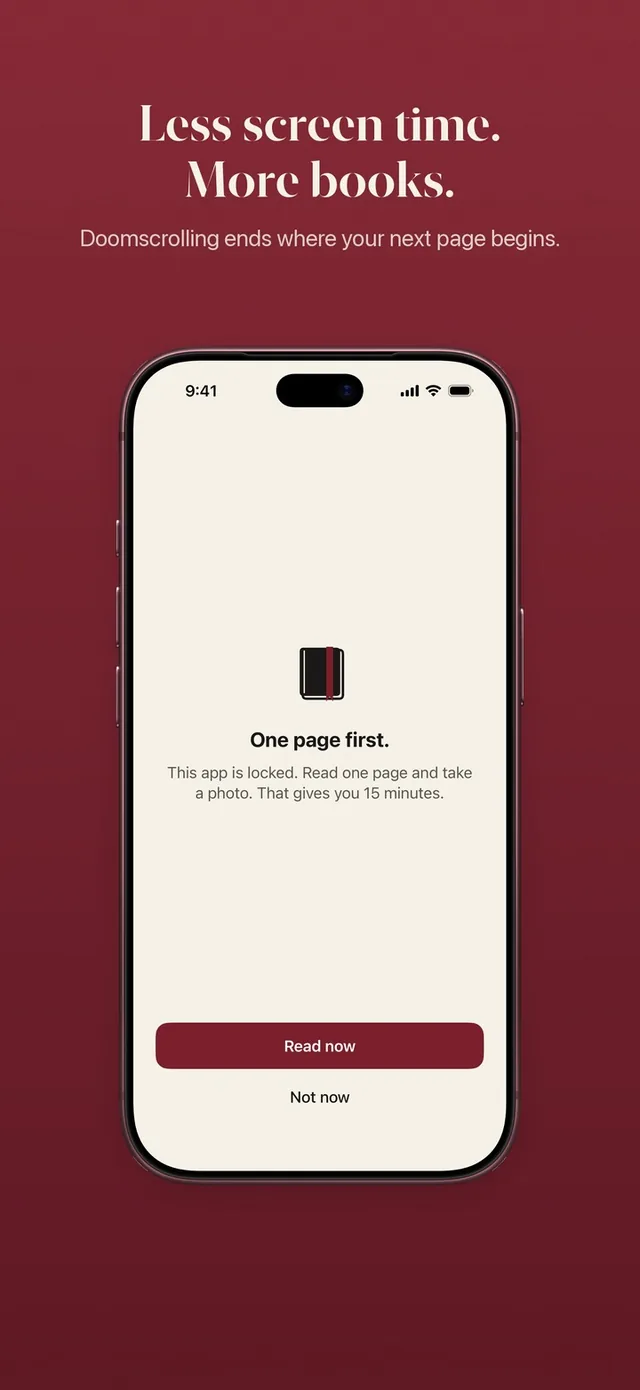
ReadFirst turns "pages first, feed after" into a rule your phone keeps. You choose the apps to lock with Apple Screen Time. When you open one, a shield says "This page can wait." To get in, you read a page of a printed book and take a live photo of it. The page is checked on your iPhone, the photo is never saved, and your apps open for the minutes your rule gives, for example 15 minutes for one page.
Those minutes only run while you use the locked apps. If you read more than the rule asks, the extra minutes go into your read-ahead bank for later that day. You can see exactly how read to unlock works, step by step, before you decide.
The result is the trade you wanted all along. The feed is still there. The book just comes first.
Try this tonight
Pick one evening and run a small experiment. It takes no app and about thirty minutes.
- Put a book you actually want to read next to where you usually scroll.
- Before you open any social app, read five pages.
- Then scroll for as long as you like.
- Before bed, write one line: how did you feel after the pages, and how after the feed?
Most people are surprised how often they skip the feed once the book has their attention. If that happens to you, you have your answer. For a fuller plan, read our guide to reading instead of scrolling.
Frequently asked questions
What is the difference between doomscrolling and reading?
Doomscrolling jumps your attention between short pieces with no end, while reading keeps it on one thread that builds and finishes. Many people feel restless after scrolling and calmer after reading.
What is bloom scrolling?
Bloom scrolling means filling your feed with uplifting or beautiful content, such as good news, art or nature, instead of distressing posts. It improves what you see but keeps the endless, fast format of the feed.
Is reading on my phone the same as reading a book?
Not quite. On a phone, the feed and notifications are always one tap away, which makes it easy to drift back. A printed book has nothing else on it, so it is easier to stay with.
How many pages should I read before scrolling?
Start with one to five pages. The goal is a rule small enough to keep every time, not a big number you skip on a tired evening.
Do I have to delete social media to stop doomscrolling?
No. Changing the order often works better than quitting: read a few pages first, then use the feed if you still want to. Many people find they want it less once the book has their attention.