You finally decide to read more, so you set a goal: 50 pages a day. The first evening goes well. On day four you come home late, you are tired, 50 pages feels like homework, and you skip it. By day ten the goal is gone and so is the habit. If you have asked yourself how many pages a day you should read, the honest answer is: fewer than you think, and every day.
The right number is not the one that sounds impressive. It is the one that still happens on the days when nothing goes to plan.
The short answer: a number you keep on a bad day
The best daily page goal is the one you would still hit on a tired, busy day. If you can picture yourself reading that many pages after a long shift, with a cold and a full inbox, the number is right. If you can only picture it on a quiet Sunday, it is too high.
For most adults that lands between 5 and 20 pages a day. Beginners and people coming back after a long break often do best with 2 to 5. People who already read most days can try 20 to 30. Anything above that is a great reading day, but a hard daily rule.
How long do pages take to read?
A page of a typical paperback takes most adults about one to one and a half minutes. That is a rough guide, not a measurement of you.
The research behind it is a large review of reading speed studies, which found that adults read English silently at about 238 words a minute for nonfiction and about 260 for fiction on average. Most adults fell between roughly 175 and 300 words a minute for nonfiction and 200 to 320 for fiction (Brysbaert, 2019, Journal of Memory and Language). Pages vary a lot in how many words they hold, so your own pace may differ.
| Pages a day | Rough time a day | Books of 300 pages a year |
|---|---|---|
| 2 | 2 to 4 minutes | about 2 |
| 5 | 5 to 8 minutes | about 6 |
| 10 | 10 to 15 minutes | about 12 |
| 20 | 20 to 30 minutes | about 24 |
| 30 | 30 to 45 minutes | about 36 |
Slower is not worse. Dense nonfiction, small print, a second language or stopping to think all take more time, and they are often the best reading you do. For the full yearly table, see how many books 10 pages a day adds up to.
How to choose your number
Choose your daily page goal from your real life, not your ideal week. Here are three quick tests.
- The bad day test. Think of your hardest typical day last month. How many pages could you have read on it? Start there.
- The time test. Find the time slot you already have: 10 minutes in bed, a 15 minute commute, lunch. Divide by one and a half minutes a page and round down.
- The book test. Look at the book you are reading. A dense history book might need a lower number than a fast thriller. It is fine to change your goal when you change books.
If the three tests give different answers, take the smallest. You can always read more. The goal is the floor, not the ceiling.
Why a small goal beats a big one
A small daily goal works because it removes the decision. When the goal is 5 pages, there is nothing to negotiate with yourself; you just read them. And once you have started, you often keep going. Many 5 page evenings turn into 20 pages without any pressure.
A big goal does the opposite. It turns reading into something to get through, and every missed day feels like failure. That feeling is what makes people quit. A small goal you meet every day builds the identity you are after: someone who reads every day.
There is also a simple math reason. Reading 10 pages every day for a year is 3,650 pages. Reading 50 pages a day for two weeks and then stopping is 700 pages. Consistency wins by a wide margin.
When to raise your goal
Raise your goal when your current one feels easy most days for two to three weeks. A good sign is that you regularly read past it without trying.
- Go up in small steps: 5 to 8, 10 to 15, 15 to 20.
- Keep a bad day floor. Even with a goal of 20, decide that 1 page still counts on a day that falls apart.
- Lower the goal without guilt when life gets busy: a new job, a baby, exams. A lower goal you keep is better than a higher one you drop.
If you think in yearly goals, like "24 books this year", translate them into pages a day. Twenty-four books of 300 pages is 7,200 pages, a little under 20 pages a day. The daily number is the one you can act on tonight. For more on choosing goals, see reading goals for adults.
Set your page goal in ReadFirst
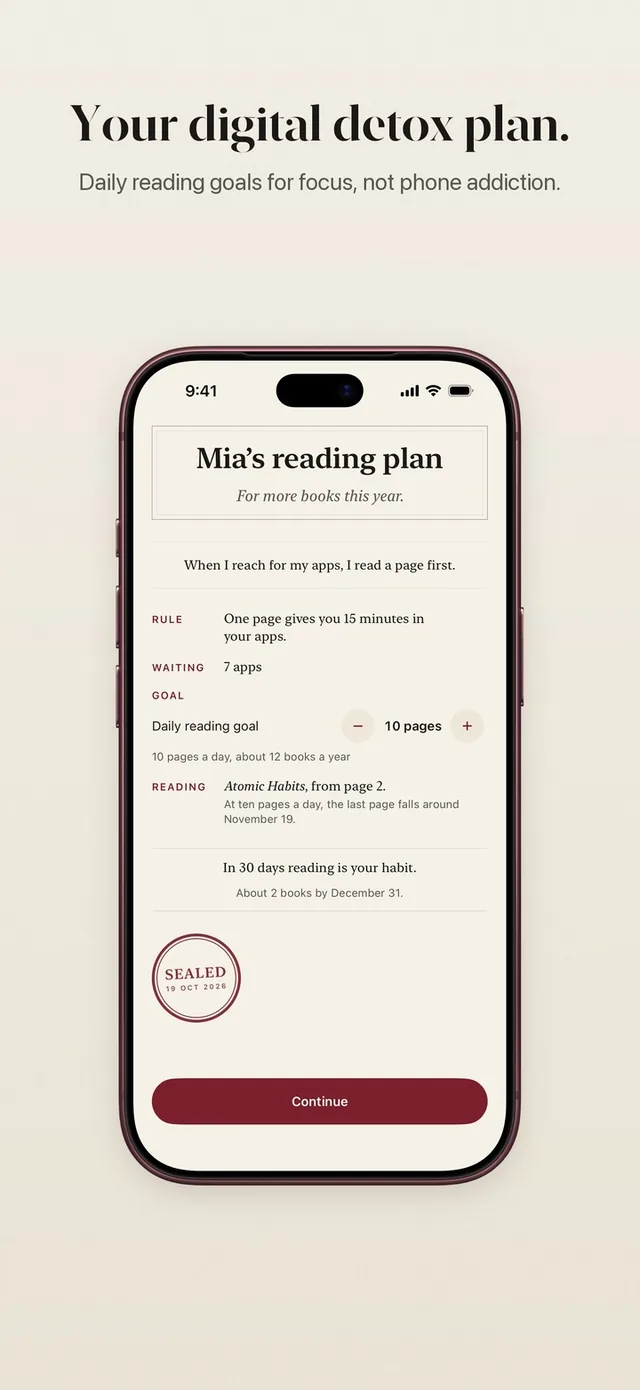
ReadFirst lets you set a daily reading goal in pages: 1, 2, 3, 5, 10, 15, 20, 30 or 50, or any number from 1 to 200 that you type in. The goal is motivation only and locks nothing. You see it on your Today screen, and your progress shows each day's pages against your goal line. See your reading goal.
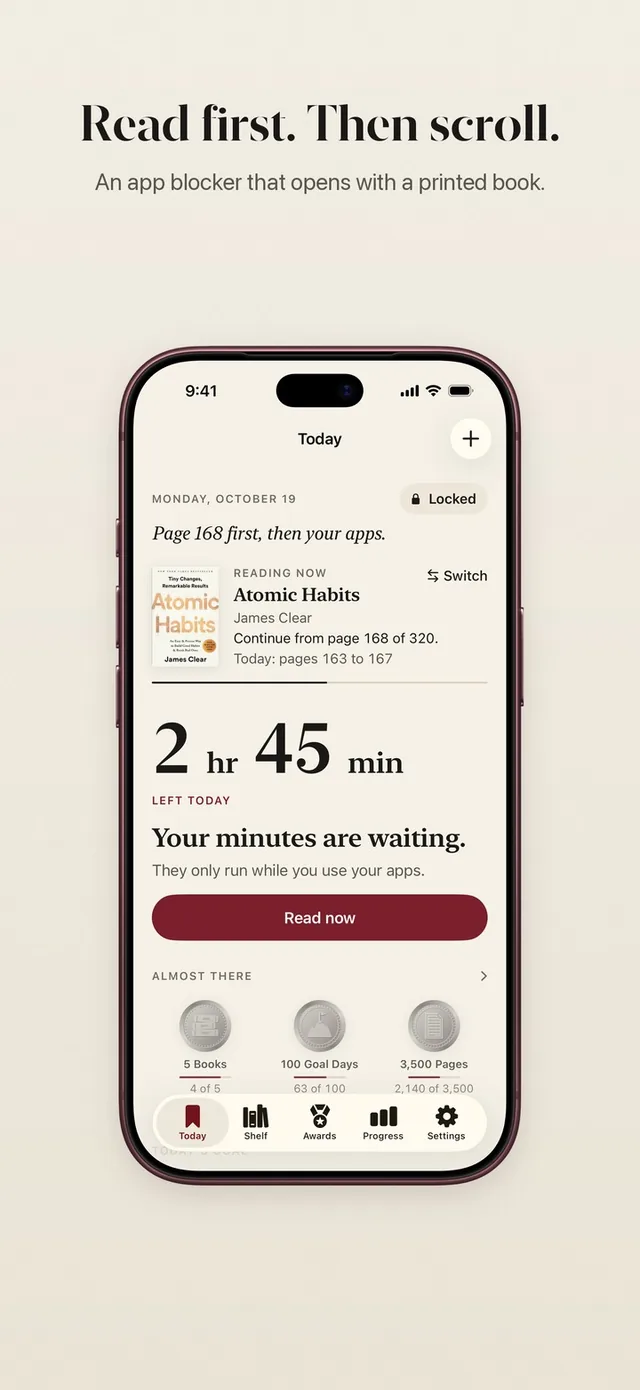
The app lock is what helps the pages happen. You choose the apps you scroll most, and they stay locked through Apple Screen Time until you read a page of a printed book and take a live photo of it. The page is checked on your iPhone and the photo is never saved. Each page you count moves your goal, your book and your reading streak at once, and your streak holds through one missed day each month.
A simple plan for this week
Here is a one-week plan to find your number.
- Day 1: Use the bad day test and pick your starting goal. If unsure, pick 5.
- Days 1 to 7: Read your goal every day at the same time, before you open your feeds.
- Each day: Note how many pages you actually read. Extra pages are fine; do not raise the goal yet.
- Day 7: If you hit the goal every day and often read more, raise it by a few pages. If you missed days, lower it.
- Week 2: Keep the new number. Stability is the point.
The right number of pages a day is the one that turns into a habit. Find it, keep it on the bad days, and the books will take care of themselves.
Frequently asked questions
How many pages a day should I read?
Read as many pages as you can keep on your worst day. For most adults that is 5 to 20 pages, about 5 to 30 minutes, which adds up to roughly 6 to 24 books of 300 pages a year.
Is 20 pages a day a lot?
Twenty pages a day is a solid goal that takes most adults about 20 to 30 minutes. It adds up to about 24 books of 300 pages a year, roughly two a month.
How many pages can you read in an hour?
Many adults read about 40 to 60 pages of a typical paperback in an hour. It depends on the book, the page size and your own pace, and dense nonfiction is usually slower.
Should I read a set number of pages or a set time?
Both work. Pages are easier to track and tie directly to finishing books, while a time goal suits people who read very different kinds of books. Choose the one you will actually keep.
What if I miss my daily page goal?
Read your normal goal the next day without making up the missed pages. If you miss often, the goal is too high, so lower it until it fits your bad days.