Every January a lot of adults set a reading goal: 25 books, 52 books, "more than last year". By March the number is quietly forgotten. Not because they stopped liking books, but because a yearly number gives no instructions for a Tuesday evening, and Tuesday evenings are where reading happens or doesn't.
A good reading goal works on the scale of your actual days. This guide compares daily and yearly goals, gives examples for different lives and shows how to pick a number you will still hit in a busy month.
Daily vs yearly reading goals
A daily reading goal tells you what to do today, while a yearly goal tells you where you hope to end up. Both have a place, but for most adults the daily goal is the one that changes behavior.
| Daily goal (pages a day) | Yearly goal (books a year) | |
|---|---|---|
| What it asks | A fixed number of pages today | A total by December |
| When you know you're on track | Tonight | Only when you do the math |
| After a bad week | Start fresh tomorrow | You're "behind" |
| Long books | Count like any other | Make the number harder |
| Feels like | A routine | A deadline |
Yearly goals also push you toward short books, since a 700-page novel "costs" as much as three slim ones. A page goal treats every page the same, so you can read what you want.
The best setup for many readers: a daily page goal you work toward, and a yearly number you simply watch grow.
Why a daily page goal sticks
A daily page goal sticks because it is small, specific and resets every day. You always know what "done" means, and missing it once doesn't put you in debt.
It also builds momentum in a way a yearly target can't. Each evening you hit your number you get a small, real finish. Those finishes are what turn reading into a habit. A yearly goal gives you one finish, eleven months away.
Pages are also more honest than minutes. Twenty minutes with your phone buzzing beside you can mean two pages. Ten pages means ten pages.
Reading goal examples by life situation
The right reading goal depends on the shape of your days, not on what other readers do. Here are realistic starting points. Books a year assume an average book of about 300 pages.
| Your situation | Daily goal | Where it fits | About books a year |
|---|---|---|---|
| Returning after years away | 2 pages | Right before bed | 2 |
| Parent of small kids | 5 pages | After bedtime, before the sofa | 6 |
| Full-time job, long days | 10 pages | Lunch break or evening | 12 |
| Commuter by train or bus | 15 pages | On the way in | 18 |
| Student | 5 pages for fun | A break between study blocks | 6 |
| Retired or more free time | 30 pages | Morning coffee | 36 |
| Already an avid reader | 50 pages | Several sessions a day | 61 |
Notice the student row: if you read a lot for school or work, a separate small goal for books you choose keeps reading something you enjoy. And the returning reader's two pages are not a typo. Starting tiny is how comebacks work. Our guide on how to get back into reading explains why.
How to pick your number
Pick the number of pages you could still read on a tired, busy, slightly annoying day. Not your best day, your ordinary bad one. That is your goal.
Then do a quick check with the math: pages per day times 365, divided by about 300 pages per book. Ten pages a day is 3,650 pages a year, about 12 books. Twenty pages is about 24. If you want to see more combinations, read our guide on how many pages a day to read.
A few rules of thumb:
- When in doubt, go lower. A goal you reach 25 days a month beats a bigger one you miss half the time.
- Raise it slowly. Once your goal feels automatic for a few weeks, go up a step, for example from 5 to 10.
- Let good days run long. The goal is a minimum. On a rainy Sunday, read 80 pages if you want.
Goals that aren't about numbers
Not every useful reading goal is a number. Alongside a daily page goal, a few gentle goals can make a year of reading richer:
- Finish the book you're reading before starting two new ones.
- Read one book in a genre you never pick.
- Reread one favorite.
- Read one book a friend recommends and talk about it afterward.
- Read on paper before screens in the evening.
Keep these as a short list, not a contract. They give your reading direction without adding pressure.
Track your goal without turning it into homework
Tracking a reading goal should take seconds, otherwise the tracking becomes the chore. A paper calendar with a mark for each goal day works. So does an app, if it counts for you.
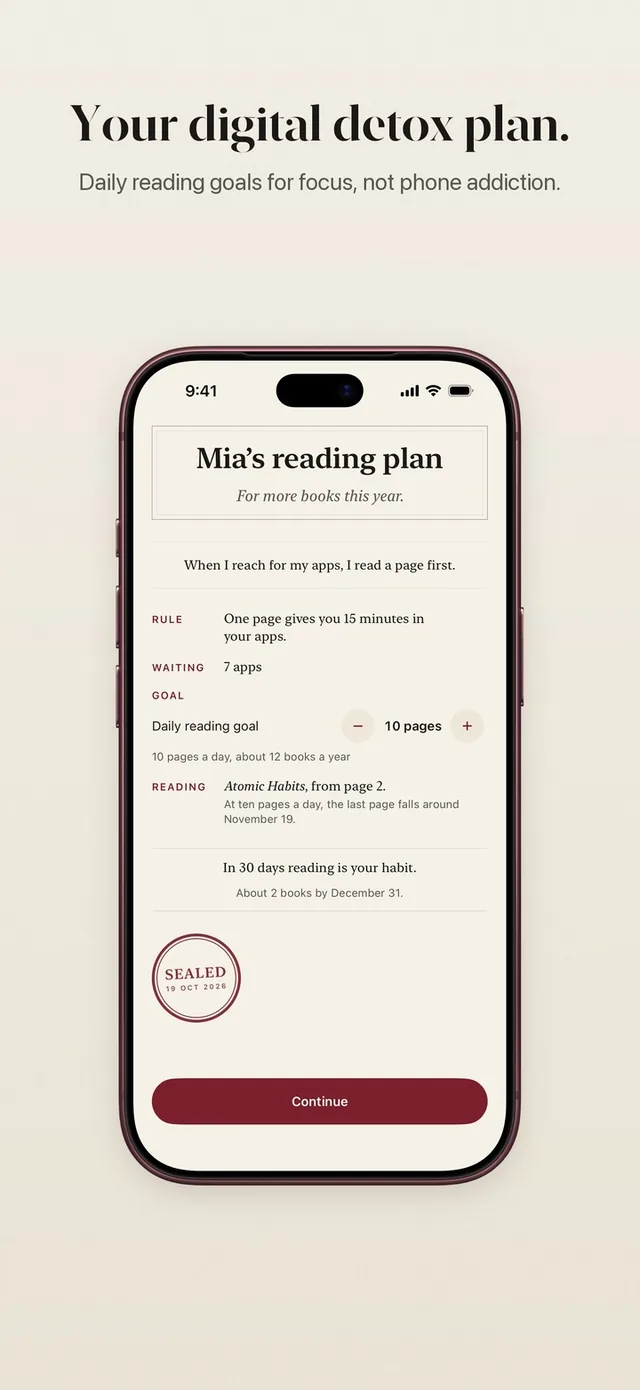
In ReadFirst you choose a daily reading goal from 1 to 50 pages in the list, or type any number up to 200. You read your printed book and take a live photo of the page, and each page counts toward today's goal on the Today tab. Your charts show the goal as a line, so a week of reading tells you at a glance which days cleared it.
The goal is motivation only. It never locks or opens anything. That's the job of your rule, if you use ReadFirst's app lock: for example, one page gives you 15 minutes in the apps you chose to lock. If you only want the tracker, set the minutes to 0 and ReadFirst runs in Track only, where every page counts for your book, your goal and your medals.
Goal Days: a reason to come back tomorrow
Goal Days are ReadFirst's medals for the days you reach your daily goal, and they don't need to be in a row. There are nine steps: your first goal day, then 5, 10, 25, 50, 100, 200, 365 and 500. A missed day never takes one away.
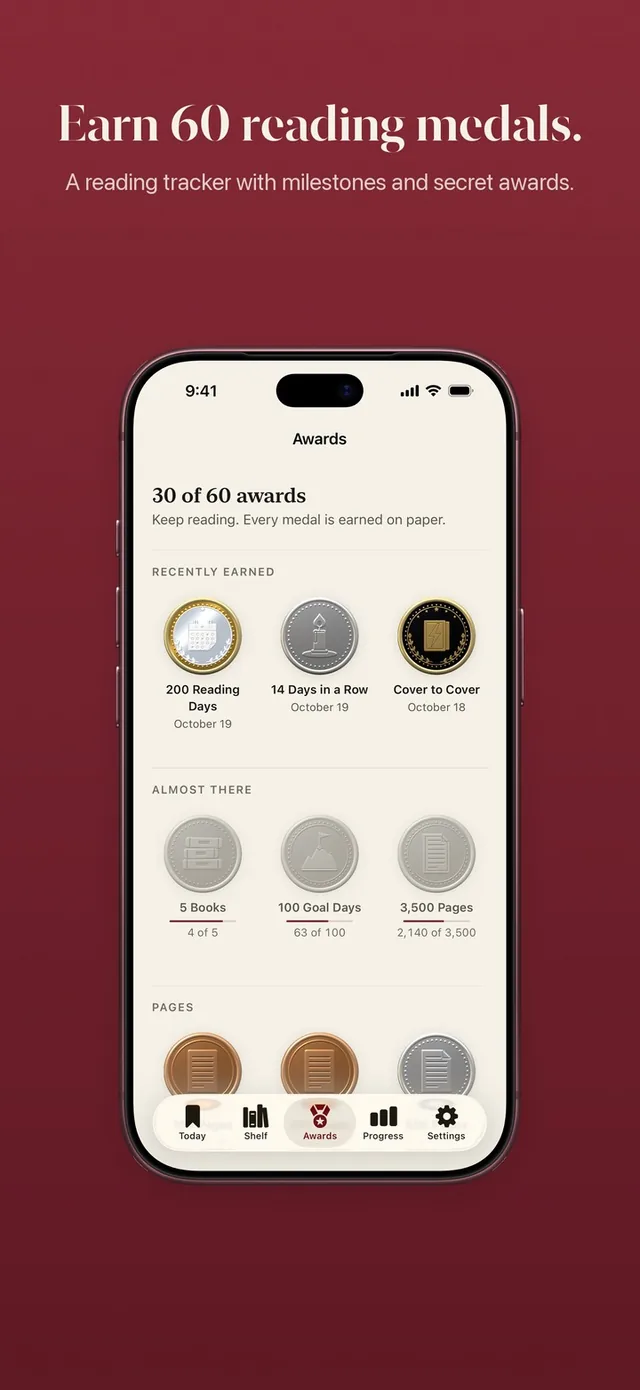
Three repeatable medals are also built around your goal: Perfect Week for reaching it all seven days of a calendar week, Perfect Month for every day of a month, and Double Goal for reading twice your goal in a single day. You can see all 60 in your reading medals.
A simple plan for your next 30 days
Here is a month-long plan to set a reading goal that lasts.
- Today: Choose your daily page goal using the table above. When unsure, take the smaller number.
- Week 1: Hit the goal every day you can. Read more only if you want to.
- Week 2: Pick one non-number goal from the list, for example a genre you never read.
- Week 3: Count your goal days so far. If you hit at least 5 of 7 each week, keep going. If not, lower the goal.
- Week 4: If the goal now feels easy, raise it one step. Then do the math and see how many books a year your new pace means.
By the end of the month, you won't be chasing a number in December. You'll be reading most days, and the yearly total will take care of itself.
A goal you keep is worth more
The best reading goal for adults is a small one you keep: a few pages a day, set for your real life, counted without effort. If you want help keeping it, ReadFirst counts every page of your printed book, shows your goal line and turns your good days into medals.
Frequently asked questions
What is a good reading goal for an adult?
A good reading goal is a daily page goal you can reach on a busy day, often 5 to 10 pages. Ten pages a day adds up to about 12 books a year of 300 pages.
Is a daily or yearly reading goal better?
For most adults a daily goal works better, because it tells you exactly what to do today and resets every day. A yearly goal is useful as a total to watch, not as the target you chase.
How many books should an adult read a year?
There is no right number. A steady pace of 10 pages a day gives about 12 books a year, and 20 pages a day about 24, assuming books of about 300 pages.
What are some reading goal examples?
Examples include 5 pages a day after the kids are in bed, 15 pages on the morning commute, finishing one book before starting another and reading one book in a new genre this year.
Does missing my reading goal in ReadFirst lock my apps?
No. Your reading goal in ReadFirst is motivation only and never locks or opens anything. Your rule decides when your locked apps open.