You sit down with a book, read a few lines and notice your hand drifting toward your phone. Not because anything happened, just because a few seconds passed without something new. Later you realize you've watched forty videos and can't remember one of them.
If that feels familiar, you are not broken and you are not alone. Attention behaves a lot like a habit: it settles into the patterns you practice most. The good news is that the same rule works in the other direction. This guide shows you how to improve your attention span with practice you can actually do, with reading at the center.
What is happening to your attention
Your attention adapts to what you give it most often. If most of your day is made of short clips, quick switches and constant notifications, then switching becomes the default and staying with one thing starts to feel uncomfortable.
Researchers have measured this shift on screens. Gloria Mark, a professor emerita of informatics at the University of California, Irvine, has studied how people use screens at work for more than 20 years. In her first paper on this, published in 2004, people stayed on one screen for about two and a half minutes on average before switching. In studies from 2016 to 2020, the average was about 47 seconds (UC Newsroom interview with Gloria Mark, 2024).
Two careful notes. First, that number measures how long people stay on one screen while working, not a fixed limit of the human brain. Second, it isn't about TikTok specifically. It describes a broader pattern of switching that short video fits right into. The useful takeaway is simple: how you spend your attention shapes how it behaves, so you can train it.
Why long-form reading is good attention practice
Reading a printed book is one of the most direct ways to practice sustained attention, because nothing in it competes for your focus. There is no autoplay, no links, no notifications and no feed refreshing itself. The only thing that moves the story forward is you, staying with it.
That makes a book a kind of gym for focus:
- It asks for one thing for a long time. A chapter holds one thread for many minutes.
- It rewards patience. The payoff of a plot or an argument comes later, not every few seconds.
- It gives clear feedback. You notice when your mind wandered, because you lost the sentence.
- It's adjustable. You can start with ten minutes and grow from there.
Paper matters here. Reading on the same phone that holds your feeds keeps every distraction one swipe away. A printed book takes them out of reach.
Start short and stretch slowly
The fastest way to improve your attention span is to start with sessions short enough to finish, then add a few minutes each week. Trying to read for an hour on day one usually ends in frustration and a phone in your hand.
Here is a gentle schedule. Read at the same time each day and try to stay with the book until the time is up.
| Week | Daily reading session | What to notice |
|---|---|---|
| 1 | 10 minutes | How often your hand wants the phone |
| 2 | 15 minutes | Whether the first restless minutes get shorter |
| 3 | 20 minutes | When you start to lose track of time |
| 4 | 25 to 30 minutes | Reading a full chapter without looking up |
If a week feels too hard, repeat it. There is no prize for speed. The point is to make staying with one thing feel normal again.
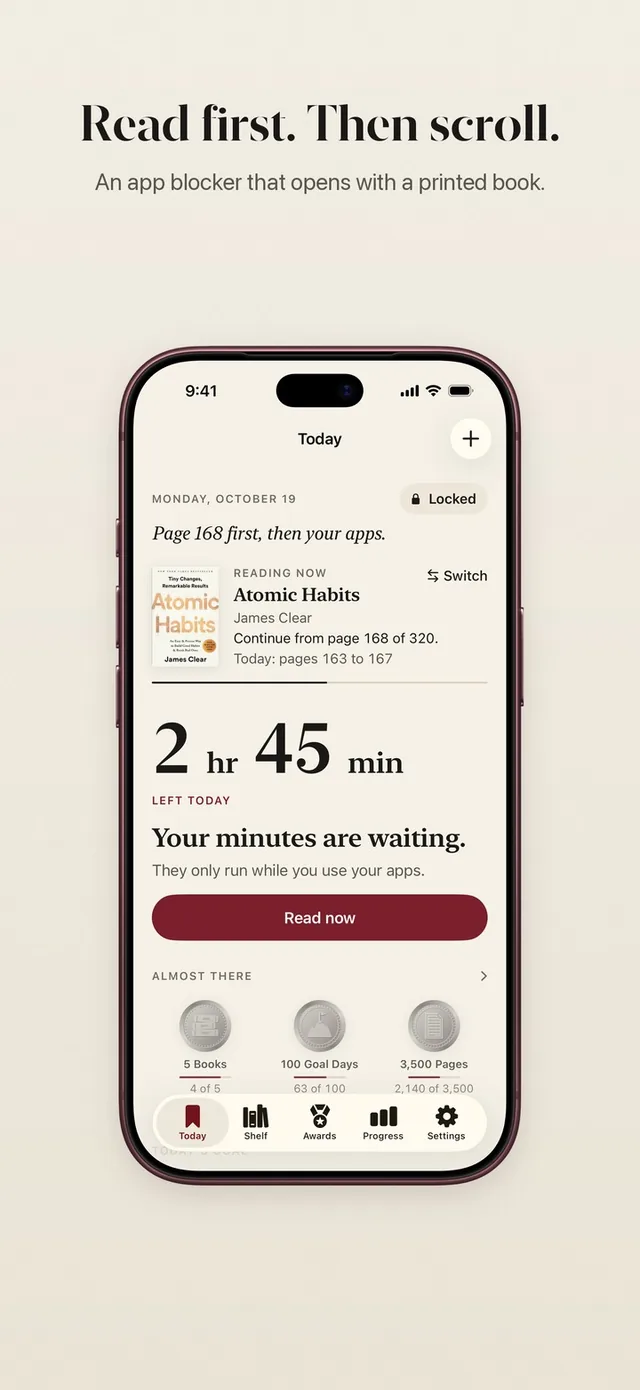
A timer helps. In ReadFirst, the reading timer starts when you tap Read now and shows on your Lock Screen as a Live Activity. If you leave to use another app, the clock pauses, so it measures only the time you actually spent with your book.
Interrupt yourself less
A large part of the switching we do is self-interruption, not outside interruption. In the same interview, Gloria Mark says that "half the time we interrupt ourselves," often out of the urge to check email or social media.
That's good news, because self-interruptions are the ones you can design away:
- Put the phone in another room while you read. Out of sight beats willpower.
- Turn off notifications for the apps that pull you most. Keep calls and messages from people you need.
- Write your goal down. Mark suggests putting your goal "in your field of view." A sticky note on the book that says "20 minutes" works.
- Notice the itch without obeying it. When you feel the pull to check, finish the paragraph first. Then the next one.
Every time you notice the urge and keep reading, you practice exactly the skill you're trying to build.
Make switching cost something
When checking your phone costs nothing, your attention pays the price instead. One way to change the balance is to put a small cost in front of the apps that pull you in, so reaching for them becomes a choice rather than a reflex.
You can do this with built-in tools: Apple's Screen Time limits, moving apps off your Home Screen or logging out of them. Each adds friction, though some are easy to skip with a tap.
ReadFirst makes the cost a few pages. You choose the apps to lock with Apple Screen Time, and when you tap one, you see "This page can wait." To open your apps by reading, you read a page or a few of your printed book and take a live photo of the last page you read. Your rule sets the trade, for example one page for 15 minutes, and those minutes only run while you use the locked apps.
The effect on attention is twofold. The reflex to check now starts a few minutes of focused reading. And the feed becomes something you choose deliberately, in a portion, instead of something that fills every gap.
Notice your attention, don't judge it
Attention improves faster when you treat lapses as information rather than failure. Everyone's mind wanders while reading. The skill is noticing sooner and coming back.
After each session, take ten seconds to ask: when did I drift, and what pulled me? Maybe it was always around minute eight. Maybe it was a buzz from the kitchen. These small observations tell you what to change next. Over a few weeks most people find the restless start gets shorter and the absorbed middle gets longer.
If reading feels especially hard right now, our guide on why you can't read anymore has more on getting through the first difficult weeks. And if you want to see how a feed and a book compare, read doomscrolling vs reading.
Try this tonight
You can start improving your attention span this evening with a 10-minute plan.
- Choose a printed book you actually want to read.
- Put your phone in another room or face down out of reach.
- Set a timer for 10 minutes.
- Read until it rings. When you feel the urge to check, finish the paragraph first.
- Afterward, note one thing that pulled your attention away.
- Do it again tomorrow at the same time. Add five minutes next week.
That's the whole practice. Small, repeated and a little longer each week.
Practice beats perfect focus
A better attention span isn't something you find, it's something you practice, and a printed book is one of the best places to do it. Short sessions, fewer self-interruptions and a little friction in front of your feed add up. If you want your phone to point you back to the page, ReadFirst puts a few pages between you and the apps that steal your evenings.
Frequently asked questions
Can you improve your attention span?
Many people find that they can stay focused longer with regular practice, such as daily reading sessions that grow a few minutes each week, and with fewer self-interruptions from the phone. Attention tends to follow the patterns you practice most.
Does TikTok ruin your attention span?
There is no simple yes or no. Research on screen use shows people switch between screens much more often than they did twenty years ago, and constant short video fits that pattern, but the habit can be changed with practice.
How long does it take to improve attention span?
It varies from person to person. A practical approach is to read daily for a few weeks, starting at 10 minutes and adding about five minutes a week, and notice whether staying with the book gets easier.
Is reading good for your attention span?
Reading a printed book is good practice for sustained attention because it asks you to stay with one thing for a long time with nothing competing for your focus.
Does ReadFirst work with e-books?
No. ReadFirst works with printed books only. The live page photo is checked on your iPhone or iPad, and screens and e-readers are not counted.