"Brain rot" became a popular word for a feeling many people recognize: scattered, foggy and restless after a long scroll, unable to settle on anything that takes more than a few seconds. It is a joke and a real complaint at the same time. The feeling is real. The word makes it sound permanent, and that part is wrong.
This guide explains what is actually going on and gives you a short daily plan to fix brain rot and feel clear again.
What brain rot really is
Brain rot is not your brain decaying. It is your attention doing exactly what you trained it to do. Short videos and feeds reward you for jumping to the next thing every few seconds. Do that for hours and your mind starts to expect a new hit constantly. Then you sit down to read, work or listen to a friend, and staying with one thing feels oddly hard.
That is good news in disguise. If attention is trained, it can be trained back. You do not need a cleanse or a device ban. You need a little daily practice at staying with one thing.
What short videos train your attention to do
It helps to be specific about what the feed teaches, because then the fix is obvious. A short-video app is built around a simple loop: a clip ends, another starts on its own, and now and then one lands that is funnier or stranger than you expected. You never know which swipe pays off, so you keep swiping. That uncertainty is the hook.
Over hours and weeks, that loop trains three things. It trains your attention to switch fast, because every clip is short and the next one is one flick away. It trains it to expect novelty on a schedule, so a pause with no new input starts to feel like something is missing. And it trains it to chase the quick payoff, which makes anything with a slow build, a chapter, a lecture, a long conversation, feel like too much for too little. None of that is a flaw in you. It is the design working as intended.
The reason recovery is realistic is that the same mechanism runs in reverse. Attention is not fixed; it adjusts to whatever you ask of it most often. Ask it to switch constantly and it gets good at switching. Ask it to stay, for ten quiet minutes a day, and it slowly gets good at staying. You are not repairing damage. You are giving a trained habit new instructions, and habits answer to repetition more than to effort. If focus has always been harder for you to hold, our guide on reading with ADHD has gentler versions of the same steps.
Signs the scroll has worn down your focus
You do not need a test. Most people recognize a few of these:
- You reread the same sentence and still miss it, because your attention keeps scanning for the next new thing and skates over the line before it registers.
- You pick up your phone with no memory of deciding to, because the reach has become a reflex that fires in any pause, before the thought to do it even forms.
- Quiet moments feel uncomfortable, because your brain now expects constant input, so stillness reads as something missing and you fill it with the feed.
- You start shows, articles or games and abandon them quickly, because a mind used to a new hit every few seconds loses patience with any payoff that builds slowly.
- You feel tired but wired, especially late at night, because scrolling keeps your brain in an alert, searching state while your body is already spent.
If these come with low mood, poor sleep or trouble in many parts of life, talk to a doctor. For an everyday case of too much scrolling, the plan below is usually enough.
The daily reset
The fix is not dramatic. It is small, repeated and boring in the best way. Four changes carry most of the weight, and you can start all of them today.
| Reset | What to do | Why it works |
|---|---|---|
| Feed-free morning | Keep the first ten minutes feed-free: water, a window, a few pages | The first input of the day sets the pace for the rest of it |
| A 10-minute focus block | Pick one thing and stay with it for ten minutes, a timer running | Trains attention to hold, the exact skill the feed wears down |
| Add friction | Move pulling apps off your Home Screen, mute non-human alerts, log out of one for a week | Every extra step turns a reflex into a choice |
| Protect your sleep | Charge the phone outside the bedroom, read a few pages before bed | Better sleep clears half the foggy feeling on its own |
For the focus block, reading is the ideal choice, because a page is built to hold a single line of thought. A timer makes it easy to start, since you know exactly when it ends; the reading timer runs that ten minutes for you and shows on your Lock Screen so you can start without opening anything else. The friction row is the heart of a good dopamine detox: you are not banning the apps, you are adding a step so that opening them becomes a decision instead of a twitch.
Why reading is the best training
Of all the calm activities you could use to rebuild focus, reading is the most direct. The skill you lost, holding your attention on one thing while your mind wants to jump, is the exact skill a page asks for. Start with five pages. In a couple of weeks, five becomes fifteen, and the foggy feeling lifts on its own.
Reading also gives back something the feed never does. You remember it, you can talk about it, and a finished book is proof the fog is clearing.
Make reading the easy choice
The hard part is not reading. It is reaching for the book instead of the phone in the moment you are tired. You can tip that moment in your favor by making the scroll a little harder and the page a little nearer.
How ReadFirst helps
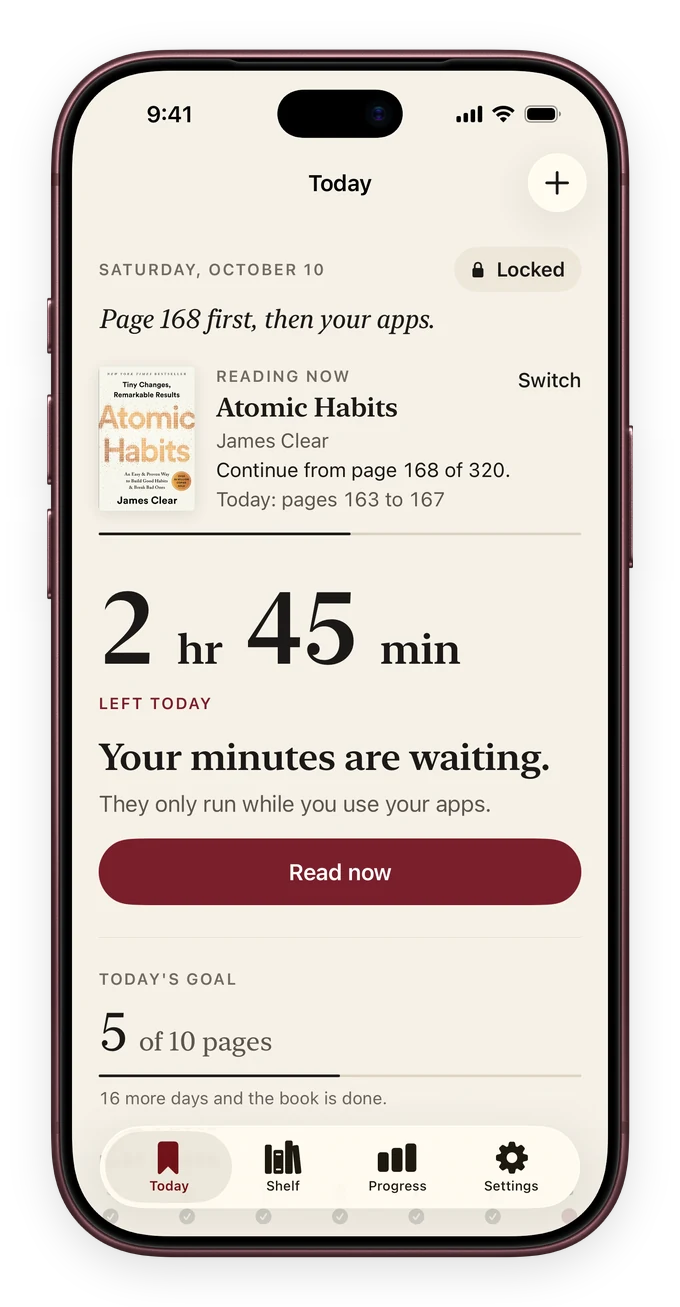
ReadFirst puts a page in front of the feed. You choose the apps to lock with Apple Screen Time, and to open them you read a page of a printed book and take a live photo of it. The page is checked on your device and never saved.
- One page, then your apps. See how read to unlock works, on your terms and at your pace.
- A gentle start. Set one page for 15 minutes and raise it when you are ready.
- Momentum you can see. A daily page goal, a forgiving streak and medals for early wins keep the new habit going.
If feeds have left you foggy and restless, the cure is not a cleanse. It is a few focused minutes a day, and a page is a fine place to start.
Frequently asked questions
Is brain rot real or just a meme?
Both. The word is a joke, but the feeling of being scattered and restless after heavy scrolling is real. It reflects a trained habit of attention, not permanent damage.
How long does it take to recover focus?
Many people feel clearer within one to two weeks of a short daily focus habit, such as reading a few pages every day. Consistency matters more than long sessions.
Does reading actually help with brain rot?
Yes. Reading trains the exact attention that fast content wears down, because a page asks you to stay with one thing. Short daily sessions rebuild it steadily.
Why does short-form video make it worse?
Short clips reward constant switching and quick payoffs, so your attention learns to expect a new thing every few seconds. That is what makes slower activities feel hard afterward.
What is the fastest first step?
Keep the first ten minutes of your day feed-free and read a few pages before you open any app. Starting the day calm sets the tone for the rest of it.