Search "dopamine detox" and you will find plans that ask you to give up your phone, music, tasty food and even conversation for a day, to reset your brain. The idea is catchy. It is also not how dopamine works. The good news is that the thing underneath it, wanting less pull from your phone and more room for things that matter, is real and very doable.
This guide separates the myth from the method. First, why the strict one-day dopamine detox fails. Then a simple daily reset you can start tonight, and keep.
What a dopamine detox gets wrong
Dopamine is a normal brain chemical involved in motivation and learning. You cannot drain it or reset it by sitting in a quiet room, and you would not want to. Your brain makes and recycles dopamine constantly; it is not a tank that empties when you avoid your phone and refills when you look at it. A day of strict abstinence can feel calming, mostly because you stepped off the treadmill of notifications for a while. But the effect fades fast when the apps come back exactly as they were.
It helps to know where the idea came from. The term became popular around 2019 under the name "dopamine fasting." The psychologist who popularized it meant something narrow and sensible: a planned break from a few specific compulsive behaviors, borrowed from a therapy technique called stimulus control, which is really just making a tempting cue harder to act on. Online, that careful version got flattened into "sit in a bare room and reset your brain chemistry," which is not what the original idea claimed and not something a day of abstinence can do. Receptors do adapt to heavy stimulation, but over weeks of changed habits, not in one afternoon.
So the strict version tends to fail for two reasons. It frames normal life, music, food, friends, as the problem. And it leans on willpower for one big day instead of changing anything about tomorrow. If fast content has left your attention feeling scattered, the fix is a steadier one; our guide on how to fix brain rot covers the same ground from the focus side.
Strict one-day detox vs a daily reset
Both come from the same instinct, but they behave very differently once the novelty wears off. Here is the honest comparison.
| Strict 1-day detox | Daily reset | |
|---|---|---|
| Effort | High for one day: give up most inputs at once | Low and repeatable: change one small thing |
| What it changes | Your mood for an afternoon | The default you reach for each day |
| Whether it lasts | Rarely; the apps return unchanged | Yes, because the change is built into tomorrow |
The one-day version feels impressive while it lasts, which is part of why it keeps going viral. The daily version is boring by comparison, and that is exactly why it sticks.
What actually helps
The useful core of the idea is simple. Some apps are built to give a quick, easy reward on a loop, and that loop can crowd out slower rewards like reading, exercise or a real conversation. You do not need to detox dopamine. You need to make the easy loop a little harder to start, and make the slower reward a little easier to reach.
Two moves do most of the work.
- Add friction to the feed. Log out, move apps off your Home Screen, or put a lock in front of them. Every extra step gives you a moment to choose. If you reach for the same app without deciding to, our guide on how to stop checking your phone has practical ways to break the reflex.
- Keep a better default in reach. A book on the couch, running shoes by the door, a clear next step for a hobby. When the easy thing is slightly harder, the good thing needs to be slightly easier.
A realistic one-week reset
You do not have to give up anything for a whole day. You change one small thing and keep it.
| Day | Change | Why it works |
|---|---|---|
| 1 | Move your three most-opened apps into one folder, off the first screen | Breaks the autopilot tap |
| 2 | Turn off all non-human notifications | Fewer pulls back to the phone |
| 3 | Put a book where you usually scroll | Makes the better choice the nearer one |
| 4 | Read 5 pages before you open any feed | Reading comes first, not last |
| 5 | Charge your phone outside the bedroom | Protects the start and end of your day |
| 6 | Pick one app to log out of for the week | Turns one reflex into a decision |
| 7 | Look back and keep what helped | Small changes that stick beat a dramatic day |
None of this is about punishment. It is about design. You are making the phone a little less automatic and your evening a little more yours.
Why reading is the replacement that lasts
Every honest guide to cutting screen time says the same thing: removing the feed only works if something takes its place. Reading is a strong choice, because it rebuilds the exact attention that fast content wears down. A page asks you to stay with one thing, and after a few weeks that gets easier instead of harder.
It also gives back something you can see. A feed is gone by tomorrow. A book moves forward, a shelf fills up, and you remember what you read. A simple reading streak can carry a shaky first week, because on a tired night you are not chasing a vague goal, you are keeping a small promise you already made.
Make reading the first instinct
This is where a small structure helps. Instead of hoping you will pick up the book, you make a page the way back into the apps you tend to open on reflex.
How ReadFirst turns the reset into a habit
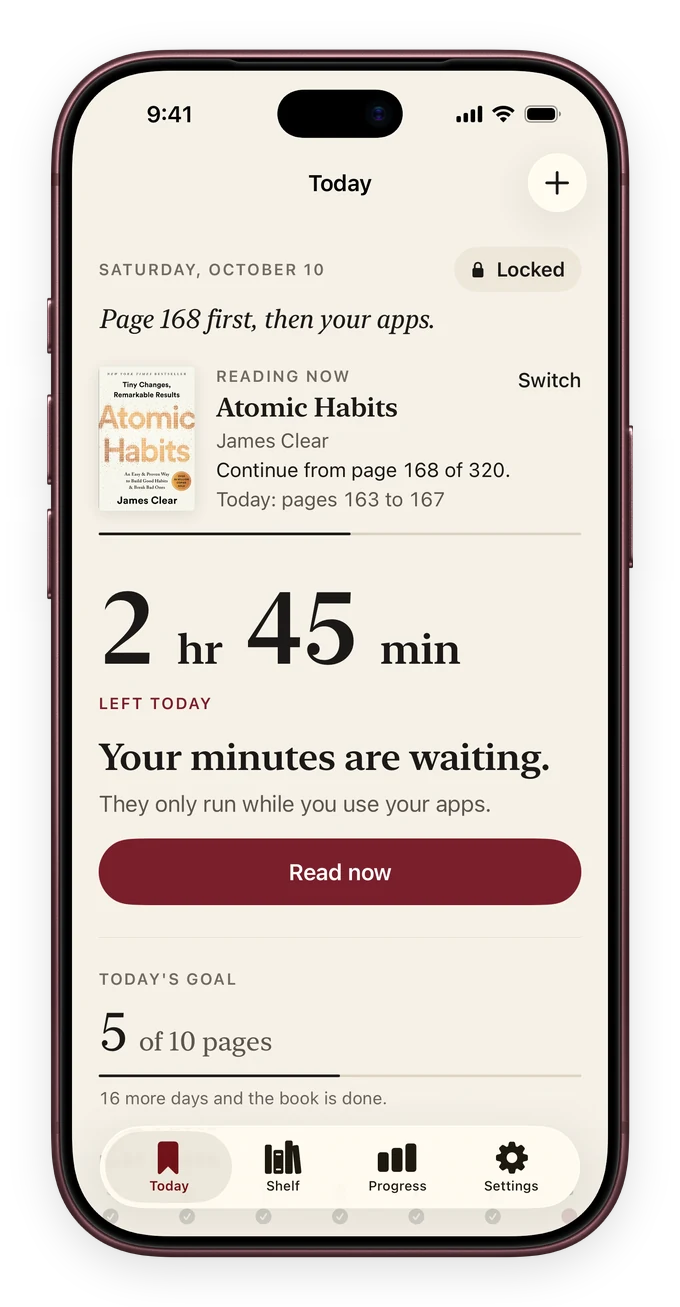
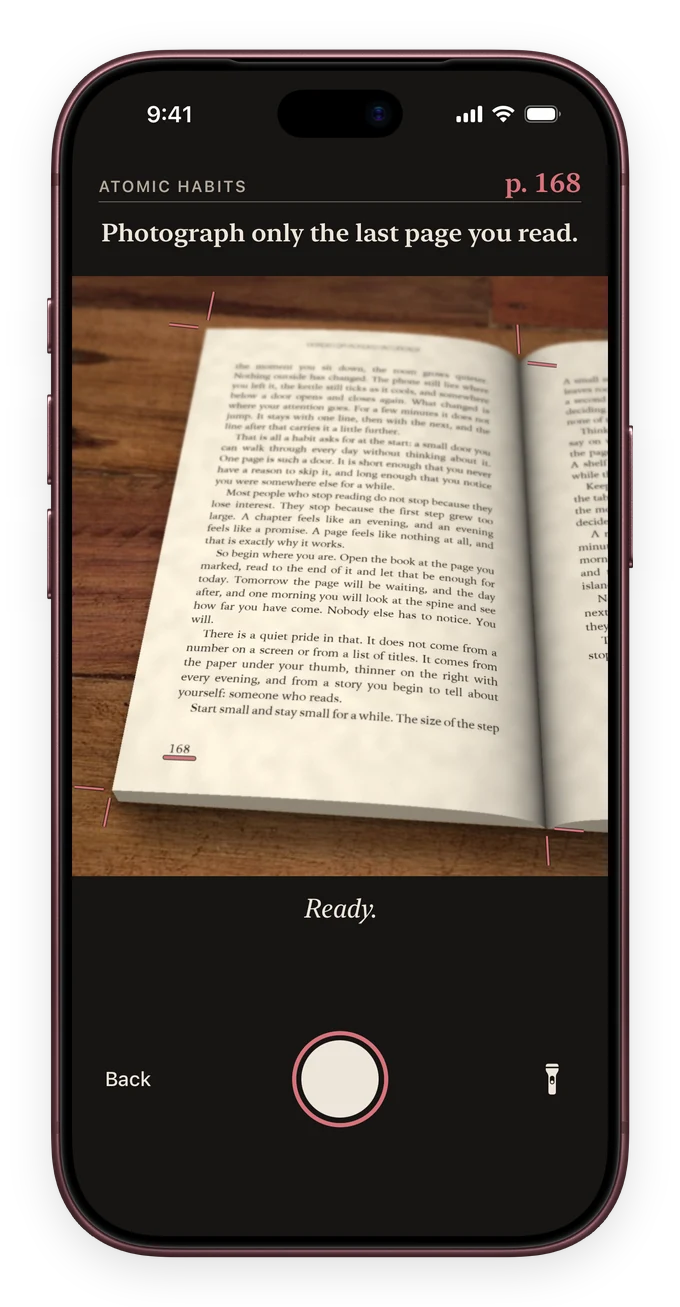
ReadFirst is built around the one move that actually works: put a small, worthwhile step in front of the easy loop. You choose the apps to lock with Apple Screen Time. To open them, you read a page of a printed book and take a live photo of it, and the apps you chose open for the time your own rule gives. The page is checked on your device and never saved.
- A page is the key, not a countdown. This read to unlock step is the concrete friction between you and the feed, and it is the whole mechanism.
- Your rule, your pace. Start as gently as one page for a few minutes and change it any time. Read more than you need and the extra pages fill a read-ahead bank for later.
- Progress you can see. A reading streak that forgives one day a month, a daily page goal and medals for early wins. No account to set up.
You can do the one-week reset above with no app at all. If the phone keeps winning, a lock that asks for a page first is the nudge that makes the new default stick.
Frequently asked questions
Does a dopamine detox actually reset your brain?
No. Dopamine is a normal brain chemical you cannot drain or reset by sitting quietly or avoiding your phone for a day. What helps is adding friction to habit-forming apps and putting a better default, like reading, within easy reach, and keeping it.
How long should a dopamine detox last?
Skip the one-day marathon. A small change you keep every day does more than a strict day you never repeat. Start with one step, such as reading a few pages before any feed, and build from there.
What should I do instead of scrolling?
Pick something slower that you value and keep it in reach: reading, a walk, a hobby. For more ideas, see what to do instead of scrolling.
Can an app really help me scroll less?
It can, if it adds a real step before the feed. ReadFirst keeps the apps you choose locked until you read a page of a printed book, so reading comes before the scroll. Photos of a screen or e-reader do not count; it has to be a printed page.