Most people who want to read faster are really asking for two things at once: to get through more pages and to still know what those pages said. That second part is easy to lose. Chase raw speed hard enough and you end up moving your eyes quickly over words you will not remember an hour later, which is not reading at all.
The honest version of how to read faster is less exciting than the courses promise and far more reliable. You get faster the same way you get faster at anything: by doing it often, with focus, and by nudging your pace up a little at a time. This guide separates what works from what does not, and gives you a daily plan you can start today.
Why most speed-reading advice fails
The popular tricks sound impressive and mostly do not survive contact with a real book.
- "Stop subvocalizing." Subvocalizing is the quiet inner voice that says the words as you read. For anything you actually want to understand, it helps more than it hurts, and forcing it off tends to trade comprehension for a number on a stopwatch.
- "Read in chunks, take in whole lines at once." Your eyes already move in jumps and take in several words per stop. Pushing far past what your eyes can clearly see means you skim and fill in the gaps with guesses.
- "Use your finger to go faster and faster." A pacer can steady a wandering eye, which is genuinely useful. Cranking the speed until you outrun understanding is not.
- Claims of thousands of words a minute. At those speeds you are skimming, not reading. Skimming has its place, but it is a different task, and it is not what you want for a novel or anything you need to retain.
The pattern is the same each time: the method boosts speed by quietly lowering comprehension, then measures only the speed. If you want to remember what you read, that is a bad trade.
What actually makes you faster
Real, durable speed comes from a handful of unglamorous things.
Read every day. This is the big one. A reader who does fifteen minutes daily will overtake a weekend crammer within weeks, because fluency is a skill and skills fade between sessions. Daily practice keeps the machinery warm. Our guide on reading 10 pages a day is a good, low-pressure target to start from.
Remove the interruptions. Much of what feels like slow reading is actually stop-start reading: a sentence, a glance at the phone, a lost thread, a reread. Put the phone in another room. A single unbroken ten-minute block beats thirty broken minutes for both speed and memory.
Build your vocabulary and background knowledge. You read familiar material far faster than unfamiliar material, because you are not stopping to work out meaning. The more you read in a subject, the quicker each new book in it goes. Speed is partly a side effect of having read a lot, which is one of the quiet benefits of reading every day.
Match the pace to the goal, and stop rereading out of habit. You do not read every page at one speed: preview the chapter, read the core carefully, and move quickly over parts you already know. And many slow readers reread lines automatically even when they understood fine the first time, so a light finger or pen under the line keeps your eyes moving forward.
Daily practice plan with timed sprints
The most effective way to raise your pace is a short daily sprint: read at a slightly brisker pace than feels comfortable for a set number of minutes, then check that you still understood it. The timer does the work. A clear end makes it easy to start, and a slight push each day is enough.
Here is a two-week plan. Keep the same easy book throughout so familiarity is not a variable.
| Days | Sprint | After each sprint |
|---|---|---|
| 1 to 3 | 10 minutes at your normal, relaxed pace | Note how many pages you read |
| 4 to 7 | 10 minutes, push a little past comfortable | Say one sentence about what happened |
| 8 to 11 | 12 minutes, finger or pen under the line | Check your page count is rising |
| 12 to 14 | 15 minutes, push slightly, then read one page slowly | Compare pages at the start and now |
Two rules keep this honest. First, after every sprint, prove to yourself you understood: summarize the passage in a sentence. If you cannot, you went too fast, so ease off next time. Second, end each session with one page read slowly and well, so your brain remembers that careful reading is the real goal and speed serves it.
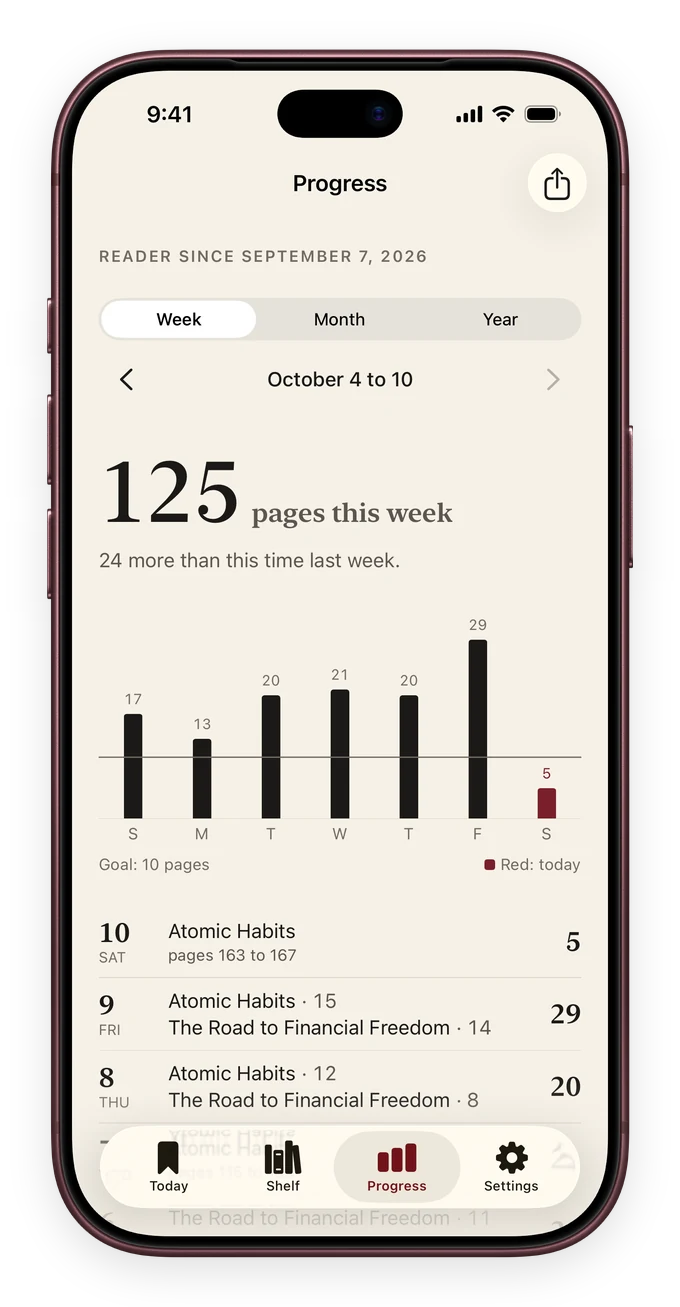
A plain kitchen timer works. If you want the counting handled for you, the reading timer in ReadFirst starts a clock you tap once and shows it on your Lock Screen as a Live Activity, so you can run a sprint without opening anything else. Over the two weeks, the reading stats show your pages and minutes adding up, which is the clearest proof that steady practice is making you quicker.
The speed-vs-comprehension trade-off
Here is the rule to keep in front of you: speed is only worth anything if you still understand and remember. A page you raced through and forgot was slower than reading it once, carefully, because now you have to read it again.
So treat comprehension as the fixed part and speed as the thing that rises within it. Push your pace until understanding starts to wobble, then settle just below that line. That edge moves outward on its own as you practice, which is exactly the point. You are not trying to hit some advertised number, only to read comfortably faster than you did last month while losing nothing.
This also means being honest about two different tasks. Skimming to find one fact, or to decide whether a book is worth your time, is a real and useful skill, and there fast and shallow is fine. Reading a story or learning something new is the opposite task, and there the goal is to stay with the page. Most of the frustration around reading faster comes from using skimming speed for a reading job.
If the deeper problem is that you cannot stay on the page at all, speed is the wrong thing to fix first. Build the sitting-still habit, then let pace follow. Our guide on how to build a reading habit covers that groundwork.
A simple way to make reading come first
Speed practice only helps if you actually open the book, and most days the feed wins that contest before you ever start. This is where ReadFirst is built to help. You choose the apps to lock with Apple Screen Time, and to open them you read a page of a printed book and take a live photo of it. The page is checked on your device and never saved. Your own rule sets how many pages give how many minutes.
The effect is simple: a short reading sprint happens first, before the scroll, every single day. That daily consistency, not any eye-movement trick, is what quietly makes you a faster reader over a few weeks. There is no account to set up.
You do not need an app to follow the plan above. But if you have tried to read more and the phone kept winning, a lock that asks for one page first turns "I meant to read" into "I read today."
Frequently asked questions
What is a realistic reading speed to aim for?
The right pace is simply a little faster than yours is now, with full understanding kept intact. Aim to beat your own page count from last month rather than chase any advertised number, because a figure that comes with lost comprehension is not progress.
Does speed reading actually work?
Genuine speed with full understanding has limits set by how your eyes and brain process language, and the extreme claims usually describe skimming. What reliably works is daily practice, removing interruptions, and widening your knowledge so familiar material flows faster.
How can I read faster without losing comprehension?
Keep comprehension as the fixed requirement and let speed rise underneath it. Push your pace until understanding starts to slip, then settle just below that edge, and finish each session with one page read slowly. Over weeks that edge moves outward on its own.
Is subvocalization bad for reading speed?
For anything you want to understand and remember, the quiet inner voice helps more than it costs, and forcing it off usually trades real comprehension for a faster stopwatch. You can let it fade naturally on very easy text, but it is not worth fighting.
How long until I notice I am reading faster?
Many people see their page count rise within one to two weeks of short daily sprints, mostly because they are interrupting themselves less and staying with the page longer. Consistency matters far more than session length.