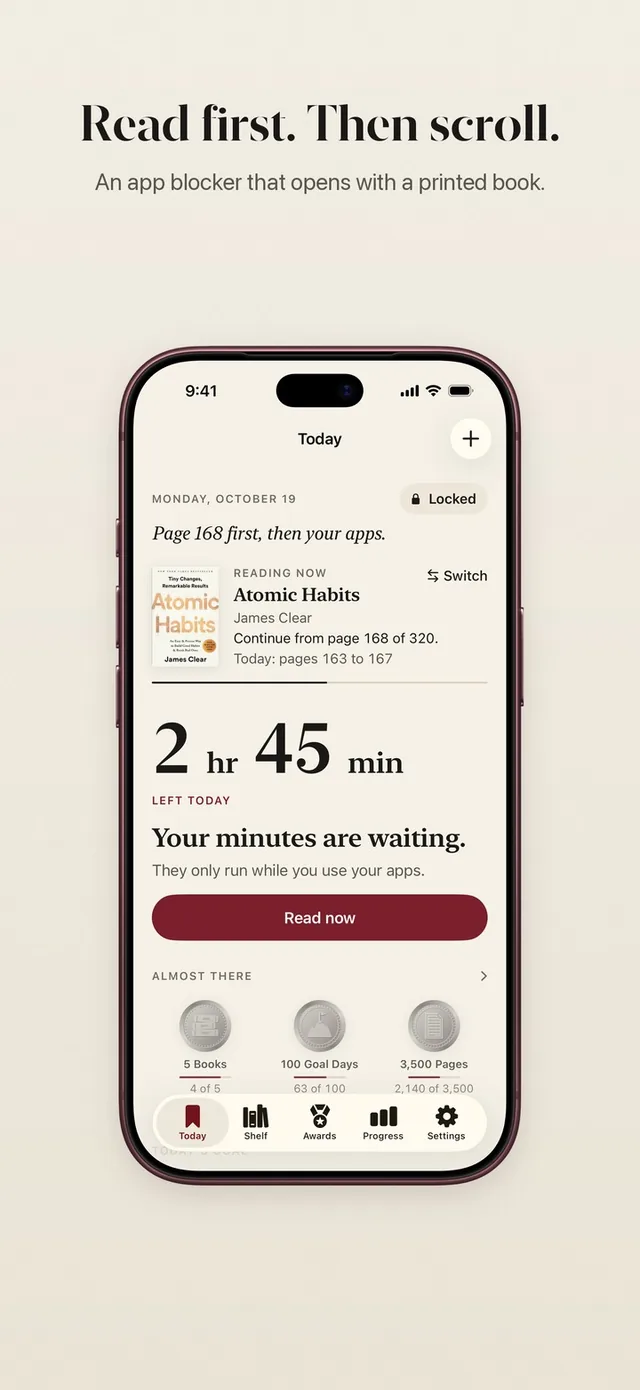
Building a reading habit as an adult rarely fails because you don't like books. It fails at 9:40 p.m., when you sit down meaning to read and your thumb is already on the icon. Twenty minutes later the evening is gone, the book is still on the nightstand and you promise yourself tomorrow.
The good news: a habit is not a matter of willpower. It is a small action repeated after the same cue until it stops needing a decision. This guide shows you how to set that up, step by step, with numbers you can actually keep.
Why reading habits fail for adults
Most adult reading habits fail because the goal is too big and the starting point is too vague. "Read more this year" has no time, no place and no size, so it loses every evening to whatever is easier. And the easiest thing in the room is almost always the phone.
Three patterns come up again and again:
- The ambitious start. You plan an hour a night, manage it twice, miss a day and feel like you failed.
- The wrong book. You pick the book you think you should read, not the one you want to read, and every session feels like homework.
- No trigger. Reading happens "when I have time", which in practice means never.
Each one has a simple fix, and together they make reading the default instead of the exception.
Start smaller than feels useful
The best starting size for a reading habit is a number of pages you could read on your worst day. For most people that is two to five pages. It sounds too small to matter, but a habit is built by repetition, not by volume, and a tiny goal is one you will actually repeat.
Small pages also add up faster than you think. Assuming an average book of about 300 pages, here is what a daily habit becomes over a year:
| Pages a day | Pages a year | Books a year (300 pages) |
|---|---|---|
| 2 | 730 | about 2 |
| 5 | 1,825 | about 6 |
| 10 | 3,650 | about 12 |
| 20 | 7,300 | about 24 |
Five pages a day is half a dozen books a year. Most evenings you will read more than your minimum, because starting is the hard part and stopping after two pages feels strange. That is the point: the small number gets you into the chair. For more on choosing a number, see how many pages a day to read.
Stack reading on a habit you already have
Habit stacking means attaching your new habit to one you already do every day without thinking. The old habit becomes the cue. The rule is simple: "After I [current habit], I read [number] pages."
Pick a cue that happens at the same point every day and that leaves you somewhere you can sit. A few that work well:
| Existing habit (cue) | Reading habit |
|---|---|
| After I pour my morning coffee | I read 3 pages at the table |
| After I sit down on the train | I read until my stop |
| After I put the kids to bed | I read 5 pages on the sofa |
| After I brush my teeth at night | I read 2 pages in bed |
| After I close my laptop for the day | I read one chapter before dinner |
Write your sentence down and put it where you will see it. One cue is enough. Adding a second reading time can come later, once the first one runs by itself.
Design your space so the book wins
Your surroundings decide more of your evening than your intentions do. If the phone is in your hand and the book is in another room, the phone wins every time. So change the distances.
- Put the book where the cue happens. On the pillow, next to the kettle, in your work bag.
- Keep a second book where you sit most. A book on the sofa armrest gets read. A book on a shelf gets admired.
- Move the phone away from your reading spot. Charge it in the kitchen or across the room at night.
- Make the spot pleasant. A good lamp, a blanket, a mug. Small comforts turn reading into something you look forward to.
- Keep a pencil or bookmark in the book. Knowing exactly where you stopped removes one more small reason to delay.
None of this needs discipline. You set it up once, and then the easy choice and the good choice are the same.
Turn your phone from a distraction into a cue
For many people the biggest obstacle to a reading habit is the phone, and it can also become the strongest cue. You already pick it up dozens of times a day. If some of those pickups led to a page instead of a feed, the habit would have a trigger that never misses.
That is what read to unlock does in ReadFirst. You choose the apps that pull you in, and Apple Screen Time locks them. When you tap one, you see "This page can wait." To open them, you read a page or a few of your printed book, then take a live photo of the last page you read. Your rule decides the trade, for example one page for 15 minutes in your apps, and the minutes only run while you use them.
The effect on a habit is simple: the reflex that used to start the scroll now starts the reading. You don't need to remember to read, because the phone reminds you every time you reach for it.
If you would rather keep your apps open for now, ReadFirst also works as a pure reading tracker. Set the minutes in your rule to 0 and it runs in Track only: every page counts for your book, your goal and your medals.
Use a streak, but forgive yourself
A reading streak is useful because it makes the habit visible: each day you read adds one more, and you don't want to break the chain. It works best with a small minimum, so one page on a hard day still counts.
Missing a day is not the end of a habit. In a well-known study of how habits form in daily life, researchers at University College London found that it took participants a median of 66 days for a new daily behavior to feel automatic, with a wide range from 18 days to a predicted 254, and that a single missed day had little impact on later progress (British Psychological Society summary of Lally and colleagues, 2010). In plain words: it takes a while, it varies a lot, and one bad day doesn't undo it.
So build in a little forgiveness. ReadFirst's reading streak gives you one grace day each calendar month, so you can miss a day and your streak holds. A daily reading goal sits next to it: the streak asks for one page, the goal asks for your full number.
A simple 30-day plan
You can build the habit in four weeks with this plan. Each step is small on purpose.
- Day 1: Write your habit sentence ("After I brush my teeth, I read 2 pages in bed"). Put the book at the cue.
- Days 1 to 7: Read your minimum every day. Stop whenever you like after that. Count days, not pages.
- Days 8 to 14: Move your phone away from your reading spot. If you use an app lock, choose the two or three apps that cost you the most evenings.
- Days 15 to 21: If the minimum feels automatic, raise it a little, for example from 2 to 5 pages. If it doesn't, keep it.
- Days 22 to 30: Look back at your month. How many days did you read? Which cue worked? Keep what worked and drop what didn't.
By the end of the month you will not have read a mountain of books. You will have something better: proof that you are someone who reads every day.
Make it easy to keep going
The habit you can keep is the one you can do tired, busy and slightly annoyed. Keep the minimum small, keep the book close and let the phone point you back to the page. If you want a gentle push, ReadFirst puts a page between you and your feed, counts your pages and celebrates the days you show up. Less scrolling, more of the person you want to be.
Frequently asked questions
How long does it take to build a reading habit?
It varies a lot from person to person. In one well-known habit study, a new daily behavior took a median of about 66 days to feel automatic, with a range from 18 to over 200 days, so expect a couple of months rather than a couple of weeks.
How many pages should I read a day to build a habit?
Start with two to five pages, an amount you can manage on your worst day. Once that feels automatic, raise it slowly, for example to 10 pages, which is about 12 books a year of 300 pages.
What is the best time of day to read?
The best time is right after a habit you already do every day, such as your morning coffee, your commute or brushing your teeth at night. A fixed cue matters more than the time on the clock.
What if I miss a day?
Read your minimum the next day and carry on. A single missed day has little effect on a habit, and ReadFirst gives you one grace day a month so your streak holds.
Does ReadFirst work with e-books or Kindle?
No. ReadFirst works with printed books only. You take a live photo of the page you read, and screens and e-readers are not supported.