Reading every day sounds like advice from a classroom poster. It is also one of the few small habits that quietly improves several parts of your life at once, not overnight but steadily, in ways you notice after a few weeks.
This is an honest look at the benefits of reading every day: the mechanism behind each one, an everyday sign to watch for, and how to make the habit stick without turning it into homework.
What a daily reading habit changes, at a glance
Each benefit below comes from a different thing a page asks of you. Here is the short version, including roughly how soon most people start to notice it.
| Benefit | How it shows up | Roughly how soon you notice it |
|---|---|---|
| Sharper focus | You stay with one task without reaching for the phone | 2 to 3 weeks |
| A calmer mind | The evening loop of notifications loosens its grip | A few days |
| Bigger vocabulary and memory | The right word arrives sooner; you hold a plot across chapters | A month or two |
| Knowledge that stays | Ideas from a book turn up later in your own thinking | Weeks, and it compounds |
| More empathy | You read the people around you a little more generously | Slow, hard to date |
| Better sleep | You fall asleep faster than after a late scroll | Within a week |
Sharper focus
Reading is attention training in disguise. A page asks you to hold one line of thought while your phone offers a dozen distractions. The mechanism is simple: every time you notice your mind drifting and pull it back to the sentence, you rehearse the exact skill sustained attention is made of. Do that daily and the muscle gets stronger.
In everyday terms, it shows up as finishing a report without flipping to another tab, or watching a film without checking the time. It is the benefit most worth protecting, because it is the same skill heavy scrolling wears down, the foggy feeling some people now call brain rot.
A calmer mind
A book is a single, slow thing in a day full of fast ones. Ten minutes with a story gives your mind one lane instead of ten. The mechanism is the narrowing itself: a feed hands you a new thing to react to every few seconds, while a page lets a single thread unspool, and reacting less is what feeling calmer is made of.
You notice it most in the evening. Where a late scroll leaves you wired, a few pages tend to settle you. Our look at doomscrolling vs reading lays out why one winds you up and the other winds you down.
A bigger vocabulary and sharper memory
Books expose you to more words, and more carefully chosen ones, than feeds do. The mechanism is repeated, in-context exposure: you meet a word inside a sentence that shows you what it means, several times across a book, until it becomes yours. Over time the right words come to you more easily.
Memory benefits the same way. Following a plot across many chapters makes you hold threads together, recalling a character from a hundred pages ago or an idea from chapter two when it pays off in chapter nine. A thirty-second clip never asks for that.
Knowledge that stays
A feed is forgotten by tomorrow. What you read in a book tends to stay, because you met it slowly and in context rather than as an isolated fact flashed past at speed. The mechanism is depth of processing: ideas you spend real minutes with, connected to a larger argument, lodge in a way a scroll cannot.
Book by book, you build a store of ideas, stories and facts that shows up later. You notice it when a point from something you read months ago surfaces in a conversation, in your own words, exactly when it is useful.
More empathy
Stories put you inside another person's head for a few hours. Fiction asks you to track what a character wants, fears and misunderstands, which is the same mental move as reading the people around you. The mechanism is perspective-taking, practiced for pleasure rather than as an exercise.
It is the slowest benefit to notice and the hardest to date, but it tends to carry over: people who read a lot of fiction often give others the benefit of the doubt a little more readily.
Better sleep
Swapping the late scroll for a few printed pages is one of the most reliable evening upgrades there is. A book ends, so a chapter gives you a natural place to stop, and paper gives off no light of its own, so you read it by a lamp you can dim.
There is careful evidence on the light part. In a small, well-run study, researchers compared reading on a light-emitting tablet with a printed book before bed (Chang et al., PNAS 2015). After the tablet, participants took longer to fall asleep, released less melatonin and felt less alert the next morning than after paper. Two honest caveats: it was a small lab study with long reading sessions, and it compared a screen with paper, not a feed with a book. The fair takeaway is modest: if you read in bed, paper looks like the gentler choice than a glowing screen.
No overnight miracle and no promises about your IQ. Just a daily habit that shapes who you are, one page at a time.
How to make daily reading stick
The benefits all come from the same thing: consistency. A few pages most days beats a long session once in a while. Here is the short version, and our full guide on how to build a reading habit goes deeper on each step.
- Start tiny. Five pages a day, small enough to keep on a bad day.
- Tie it to a cue. Morning coffee, the commute, the moment before sleep.
- Pick books you enjoy. Momentum beats prestige.
- Keep the phone out of reach. Out of sight is easier than resisting.
- Count the days, not the pages. Showing up is the win.
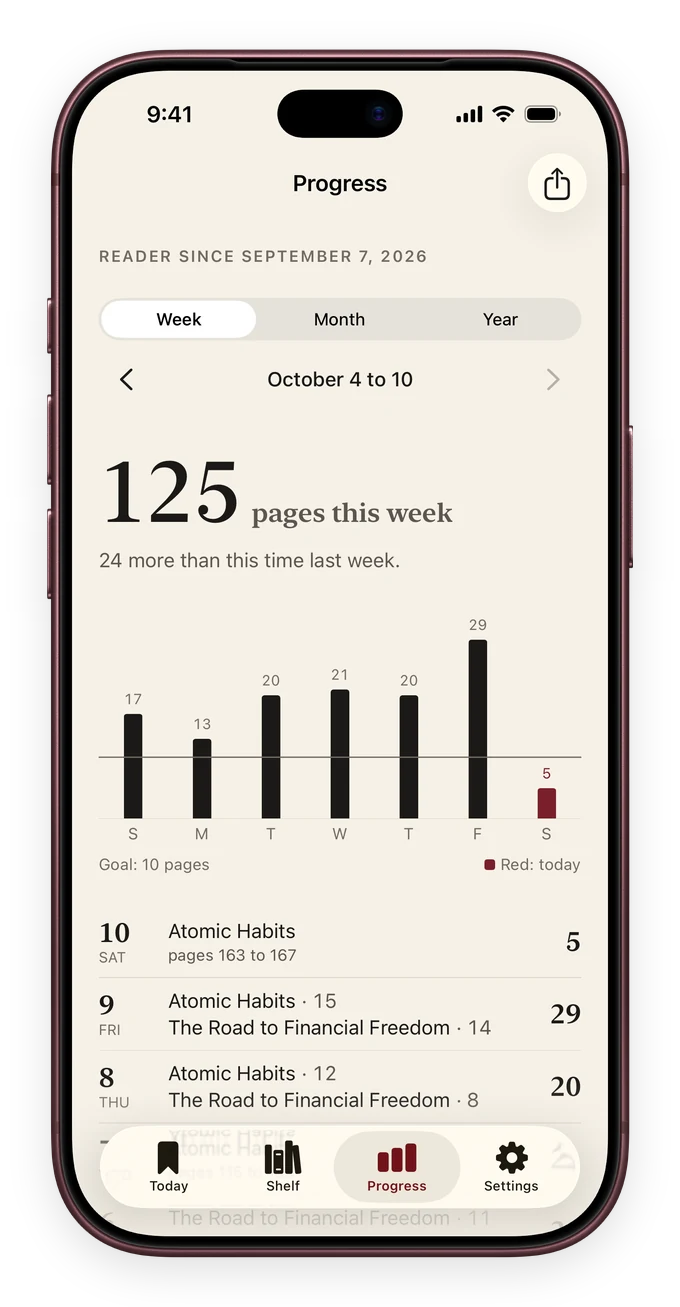
A small, visible target helps more than willpower here. A daily reading goal turns "read more" into one number you can meet, which is the scaffold most habits are missing.
Put reading before the scroll
The main thing standing between you and a daily reading habit is usually the phone. The fix is not willpower, it is order: read a few pages first, then open your apps. When reading comes first, you are not fighting the urge to scroll; you are using it as the reminder to read.
How ReadFirst helps
ReadFirst makes a page the way back into your apps. You choose the apps to lock with Apple Screen Time, and to open them you read a page of a printed book and take a live photo of it. The page is checked on your iPhone and the photo is never saved. The benefits above come from doing this daily, and ReadFirst is built to make daily easy.
- A forgiving reading streak. A day counts when you read, with one grace day a month.
- A small daily page goal you can actually hit.
- Reading first, by design. Because a page opens your apps, the habit happens before the scroll.
Pick a small number, tie it to a moment you already have, and let a few pages a day do the quiet work. If you are starting from a long gap, our guide on why you can't read anymore is a gentle place to begin.
Frequently asked questions
How long should I read each day to see benefits?
Even ten minutes a day helps if you keep it up. Consistency matters more than length, and short daily sessions are easier to sustain than occasional long ones.
Which benefit of reading shows up first?
A calmer evening tends to come first, within days of swapping a late scroll for a few pages. Sharper focus takes two to three weeks, and the deeper benefits like vocabulary and knowledge build over a month or more.
Is reading before bed actually good for sleep?
For many people, yes. A printed book ends and gives off no light of its own, and in one careful study people fell asleep faster after reading on paper than after a light-emitting tablet. A few pages instead of a bright screen helps the mind wind down.
Does the type of book matter?
Not much, when you are building the habit. The best book is the one you will actually read, so choose something you enjoy rather than something that sounds impressive.
Is reading on a phone as good as a printed book?
The thinking benefits are similar, but a printed book has no feed or notifications competing for your attention, so most people focus better on paper and sleep better after it.