You sit down to study. You read one line of the chapter, then your hand drifts to the phone to "just check something". Forty minutes later the page is exactly where you left it, and the session that was supposed to take an hour has eaten your whole evening. If that sounds familiar, the problem usually is not your willpower or your intelligence. It is the device sitting six inches from your notes.
This guide gives you a plain method for studying with focus, built for students and self-learners. No productivity theater, no twenty-step morning routine. Just a setup you can repeat tonight.
Why your phone is the biggest study leak
Most study advice treats focus as something you summon with enough discipline. In practice, focus is mostly about what you let near you. A phone on the desk is not neutral. It is a stack of apps built to pull your attention and keep it, and it does that whether or not a notification arrives, because you have learned that a quick check sometimes pays off.
The real cost is not the two minutes you spend scrolling. It is the restart. Every time you switch away from a problem set and back, your brain has to reload where you were and what you had half-figured-out. That reload is slow and tiring, and after enough of them the session feels exhausting even though you barely studied. A reachable phone chops your hour into useless fragments.
So the first question is not "how do I focus harder". It is "how do I make the phone a non-option for the next stretch". Everything below follows from that.
The phone-away setup
The fix that beats every clever technique is also the most boring: put real distance between you and the device. Out of sight is far easier than resisting, because you are not spending energy saying no every few minutes. You simply removed the choice.
A setup that holds:
- Different room, not face down. On the desk, even screen-down, the phone keeps a thread of your attention. Leave it in another room, in a bag, or on a shelf across the house.
- Silence the buzz at the source. A phone in another room still interrupts if it rings through a watch or laptop. Turn off notifications for the study window, or use Focus mode so nothing pings any of your screens.
- Lock the apps you actually lose time to. Be honest about which two or three apps swallow your sessions, and put a real barrier in front of them rather than trusting yourself to ignore them.
That last point is where Apple Screen Time helps, though its limits are easy to tap past in a weak moment. If you have found yourself hitting "Ignore Limit" on autopilot, our guide on how to lock apps on iPhone until you read walks through a barrier that asks for something real before an app opens. For the wider picture of cutting back, see how to reduce screen time on iPhone.
Timed study blocks that hold
Once the phone is away, give the session a shape. An open-ended "study until you're done" is hard to start and easy to quit. A timed block is the opposite: it has a clear beginning, a clear end, and a promise that a break is coming. That makes it far easier to sit down and begin, which is the hardest part.
Pick one of these rhythms and set an actual timer, not a vague intention:
| Block | Study | Break | Best for |
|---|---|---|---|
| Short | 25 minutes | 5 minutes | Hard starts, low energy, dense material |
| Standard | 50 minutes | 10 minutes | Steady work, essays, problem sets |
| Deep | 90 minutes | 20 minutes | Big projects once your focus is warmed up |
Start smaller than feels impressive. A 25-minute block you actually finish beats a 90-minute block you abandon at minute 30. When the timer rings, take the break away from the desk, and leave the phone where it is if you can, because a break spent scrolling tends to swallow the next block too.
During the break, stand up and rest your attention rather than swapping one screen for another. If you want to understand why a few weeks of this rebuilds the focus that feeds and short videos wore down, read how to improve your attention span.
Earn your scroll with pages
Here is the shift that makes the whole method stick: stop treating phone time as the default state you keep interrupting, and start treating it as something you earn. Flip the order. Before the feed gets a minute of your evening, the study gets its block.
A concrete version of this: read or work through a set number of real pages first, then allow yourself a measured stretch of scrolling. You are not banning the phone forever. You are putting it after the work instead of tangled up inside it. When the reward comes second, you are no longer fighting the urge during the session, because the urge has somewhere to go once the block is done.
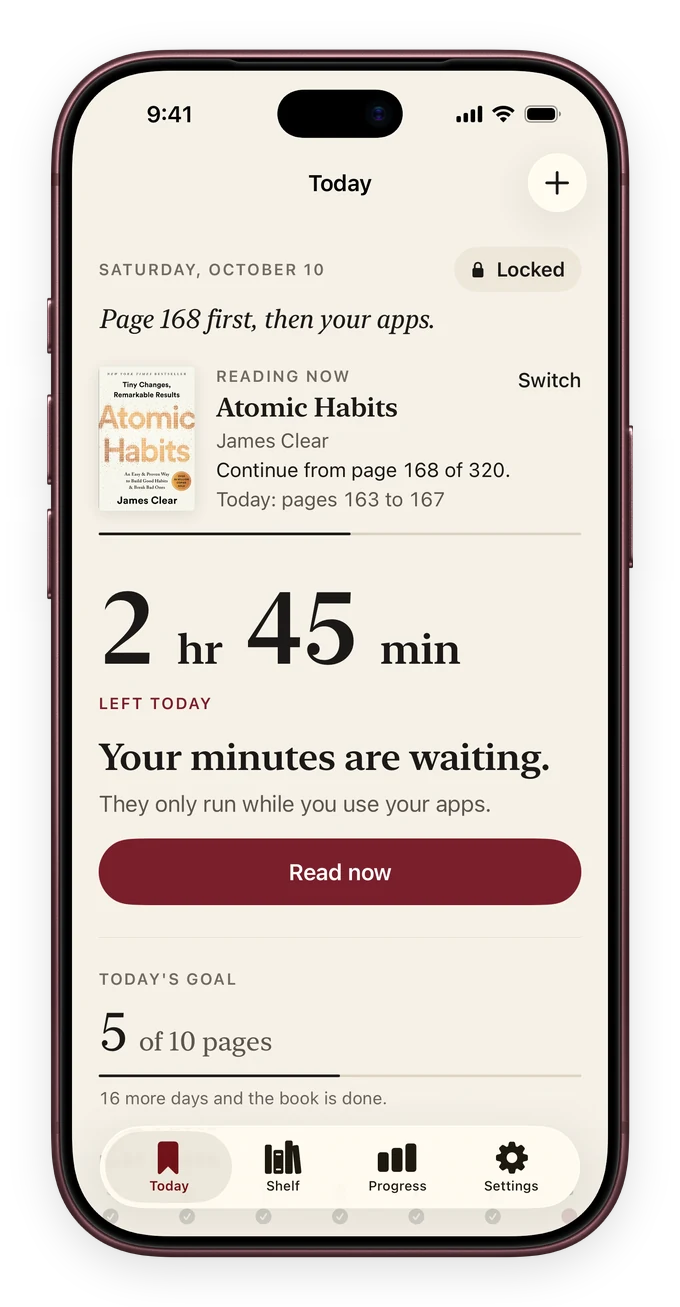
This is exactly what ReadFirst is built around. You choose the distracting apps to lock with Apple Screen Time, and to open one you read a page of a printed book or your actual study material and take a live photo of it. The page is checked on your device and never saved. Your own rule decides how many pages buy how many minutes, so you set the exchange rate that fits your study load. The read-to-unlock barrier turns a mindless tap into a small, honest ask: one more page first.
Two more parts make study sessions easier to hold. The reading timer starts a clock when you begin and shows it on your Lock Screen, so you can see the block running without opening anything else. And a daily reading goal lets you pick a small page target and watch it fill through the day, which gives an open evening a finish line instead of a void.
Handling the urge to check
Even with a clean setup, the urge to grab the phone will show up, usually right when the material gets hard. That urge is not a sign the method failed. It is the exact moment the method is working, because the hard part is where the real studying happens.
A few ways through it:
- Name it and park it. When "I should check my messages" pops up, write the thought on a sticky note and return to the page. Most of the notes turn out not to matter by the time the break arrives.
- Ride the wave. The pull to check tends to crest and fall within a few minutes if you do not act on it. Finish the current block first, and the urge is usually gone by the time it ends.
- Make the reach cost something. If the phone is in another room behind a locked app, checking it means standing up and reading a page. That small friction is often enough to let the moment pass.
- Count the block, not the mood. Whether a session felt focused or scattered, it counts if you stayed in the chair. Focus is a skill that grows with reps, and you only get reps by finishing imperfect sessions.
You do not need an app to use any of this. The phone-away setup and timed blocks work on their own, tonight. But if you have tried before and the phone kept winning the quiet battle at your desk, a lock that asks for a real page first can be the thing that finally tips the session your way.
Frequently asked questions
How can I focus while studying if my phone keeps distracting me?
Put the phone in another room, turn off notifications for the study window, and lock the two or three apps that eat your time so opening them is not a reflex. Then work in timed blocks with a clear end. Distance beats willpower, because you stop spending energy resisting a device you can no longer easily reach.
How long should a focused study block be?
Start with 25 minutes of work and a 5-minute break, then grow to 50 and 10 as your focus warms up. A shorter block you actually finish is worth more than a long one you abandon halfway. Match the length to the day: harder material and lower energy call for shorter blocks.
Should I study on paper or on a screen?
For the reading itself, paper has nothing else on it, so there is no feed or notification one swipe away. Many students find they hold a page far longer on paper than on a device. Use screens for what truly needs them, and keep the phone itself out of the room while you work.
What do I do when I get the urge to check my phone mid-session?
Write the thought on a sticky note and keep reading. The urge usually crests and fades within a few minutes if you do not act on it, so finish the current block first. Parking the thought instead of acting on it keeps you in the session without feeling like you are denying yourself anything.
Does earning phone time by reading actually help focus?
It helps because it reorders your evening. Instead of scrolling by default and interrupting it to study, you study first and let a measured stretch of phone time be the reward. With the pull given a place to go after the block, you spend the session working rather than fighting the urge.