It is 10:30 pm. You are in bed, lights off, phone in hand. You only meant to check one thing. At 11:45 you are still scrolling, wide awake, slightly annoyed with yourself, and the book on the nightstand has not moved in days.
Reading vs scrolling before bed is one of the most common choices we make, and we make it on autopilot. This guide looks at what we actually know about the two, without overselling the science, and gives you a routine that makes the book the easy choice.
Reading vs scrolling before bed: the short answer
For most people, a printed book is the better way to end the day than a feed. Three plain differences explain why:
- A book ends. Chapters give you a natural place to stop. A feed never runs out, so bedtime keeps moving.
- A book is quiet. No notifications, no comments, no breaking news to react to at midnight.
- A book has no screen. Paper does not glow. You read it by a lamp you can dim.
None of this needs a lab to prove. Most people already know how they feel after an hour of feed in bed versus twenty minutes of a novel. Still, it helps to know what the research does and does not say.
What one careful study found
A small but well-run study from researchers at Brigham and Women's Hospital compared reading on a light-emitting tablet with reading a printed book before bed. Twelve healthy young adults lived in a sleep lab for two weeks and read for about four hours before bedtime on five evenings with each format, in dim room light (Chang et al., PNAS 2015).
After reading on the tablet, participants took longer to fall asleep, felt less sleepy in the evening, released less melatonin and felt less alert the next morning than after reading the printed book. The authors point to the light the device gives off as one likely reason.
Two honest caveats:
- It was a small lab study. Twelve people, long reading sessions, strict conditions. Real bedrooms are messier.
- It compared reading on a screen with reading on paper, not reading with social media. A feed adds things the study did not test, like news, messages and the pull to keep going.
So the fair takeaway is modest: if you read in bed, paper looks like the gentler choice for your evening than a glowing screen. That is enough reason to keep a printed book on the nightstand.
Why scrolling keeps you up later than you planned
The biggest cost of scrolling in bed is often time, not light. A feed has no end and every swipe brings something new, so "five minutes" quietly becomes an hour. A book gives you a chapter break every so often, and each one is an easy moment to turn off the lamp.
Scrolling also tends to wake your mind up. A heated comment thread, a worrying headline or a message that needs an answer can keep you thinking long after the phone is down. A story or an idea in a book tends to settle you instead, because it asks you to follow one thread rather than react to fifty.
If late-night scrolling is your main struggle, our guide on how to stop doomscrolling before bed goes deeper into breaking that loop.
A simple evening routine: book before feed
The easiest evening routine is one where the book is closer than the phone. You do not need willpower if the setup does the work.
- Choose tonight's book in the afternoon. Something you enjoy, not something you feel you should read. Put it on your nightstand or pillow.
- Charge your phone away from the bed. Across the room, in the hall or in the kitchen. If you use it as an alarm, a cheap alarm clock solves that.
- Set a reading start time. For example 10 pm. Treat it like brushing your teeth: it just happens.
- Read at least five pages. On a tired night, five pages is a win. On a good night, keep going.
- Stop at a chapter break. Finish the chapter, close the book, turn off the lamp.
- If you still want the phone, read first. A few pages before any feed. Most nights, you will not want it by then.
Ten pages a night adds up. At 10 pages a day you read 3,650 pages a year, which is about 12 books if you assume an average book of 300 pages.
What to read at night
The best bedtime book is one you look forward to but can put down. Very intense thrillers can keep you up just like a feed. Some ideas that work well:
| Works well at night | Better for daytime |
|---|---|
| A gentle novel or a reread you love | Page-turners with cliffhangers every chapter |
| Short essays or stories | Dense nonfiction that needs notes |
| Memoirs and travel writing | Work books and study material |
| Poetry, a few pages at a time | Anything that worries you |
Keep two books going if you like: a calm one for bed and a gripping one for the train.
Make the phone the harder choice at night
The routine above works best when the phone is not one tap from the pillow. If you keep it close, make the feed cost something first. That is the idea behind ReadFirst.
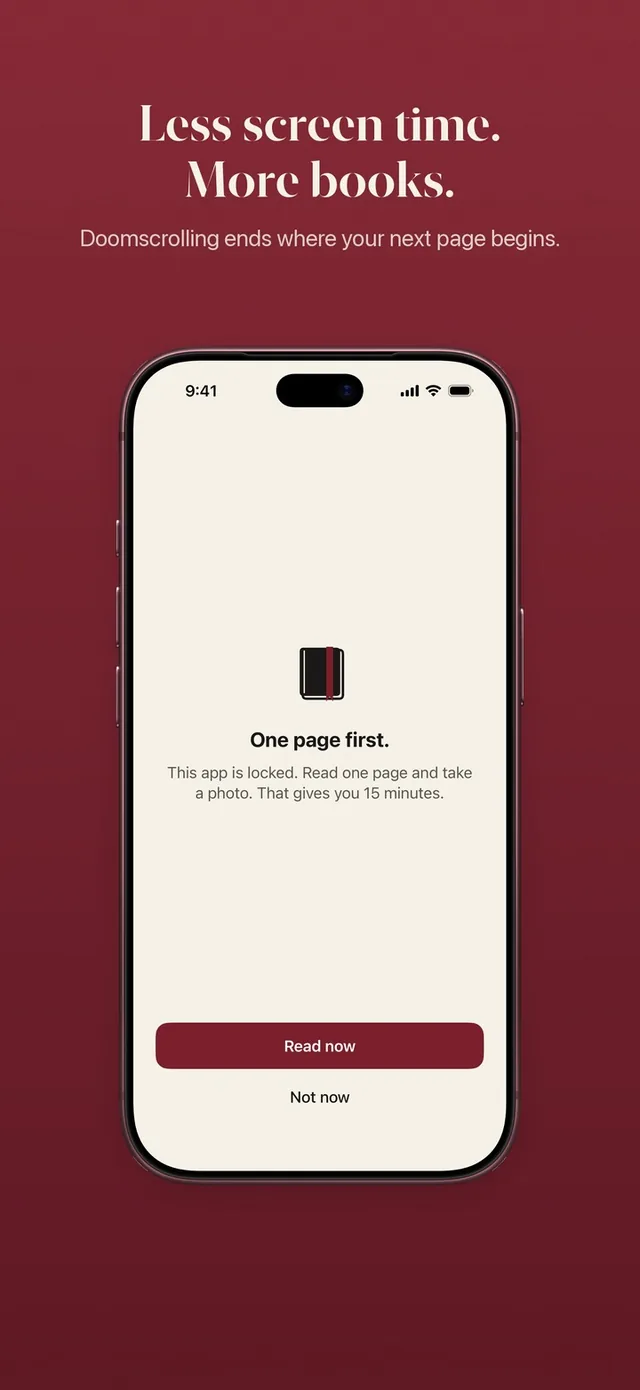
You choose the apps to lock with Apple Screen Time. When you open one in bed, a shield says "This page can wait." To get in, you read a page of a printed book and take a live photo of it. The page is checked on your iPhone and the photo is never saved. Your rule decides how much time a page gives, so the feed is still there when you want it, just after the book. See how read to unlock works in detail.
A few things make it fit an evening:
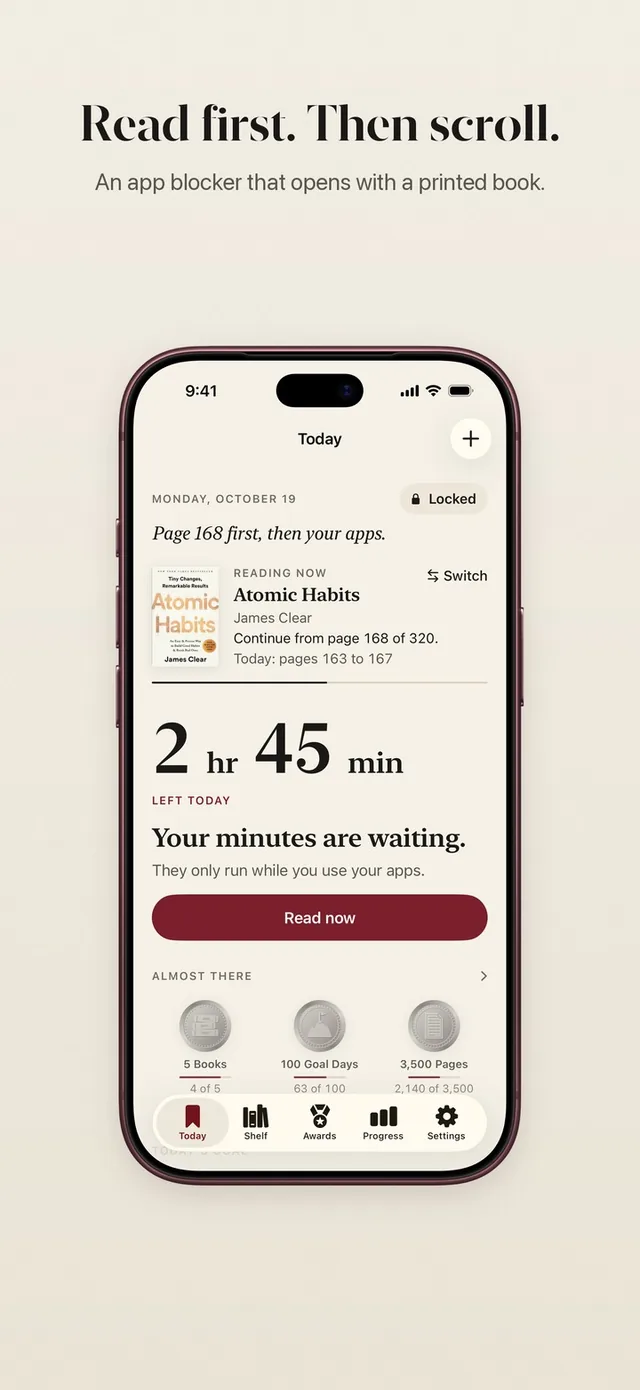
- The reading timer starts with Read now and shows on your Lock Screen, so you can read without opening other apps.
- A daily page goal gives you a small target for the night, like 5 or 10 pages.
- A streak reminder reads "Your streak ends at midnight. One page is enough." On a long day, that one page keeps the habit alive.
- Every day starts locked at midnight, so last night's reading does not cover tonight's scrolling.
Try this tonight
Tonight, run the smallest version of the routine.
- Put a book on your pillow now.
- Plug your phone in somewhere you cannot reach from bed.
- In bed, read five pages before anything else.
- Tomorrow morning, notice: when did you fall asleep, and how did the evening feel?
Try it for one week and compare it with the week before. For more ways to swap the feed for a book during the day too, read our guide on doomscrolling vs reading.
Frequently asked questions
Is reading before bed better than scrolling?
For most people, yes. A printed book ends, has no notifications and gives off no light of its own, while a feed never ends and keeps your mind busy. Many people find they fall asleep more easily after a few pages than after an hour of scrolling.
Is reading on my phone before bed as good as reading a book?
Not quite. In a small lab study, people took longer to fall asleep after reading on a light-emitting tablet than after reading a printed book. A phone also keeps notifications and other apps one tap away.
How long should I read before bed?
Ten to twenty minutes is a good start, or five to ten pages. Stop at a chapter break so you have a clear end.
What if I fall asleep reading?
That is fine and a sign the routine is working. Use a bookmark, keep the lamp within reach and pick up where you left off tomorrow.